

The Compendium Podcast
Biosphere 2: Why the Experiment Could Not Breathe
Eight people sealed themselves inside Biosphere 2 to prove humans could survive in a closed ecosystem. Falling oxygen, failing crops, and media scorn soon turned the grand experiment into a fight to breathe.
Biosphere 2: The Grand Experiment That Could Not Breathe
Biosphere 2 was supposed to answer one of humanity’s biggest questions: if Earth became hostile, could we build a second world and survive inside it? In the Arizona desert, under glass and steel, eight people stepped into a sealed ecosystem designed to mimic the interdependence of life on Earth and test whether a future Mars habitat might be possible.
What they entered was not just a giant greenhouse. It was a man-made planet in miniature, complete with rainforest, desert, wetland, ocean, farmland, animals, atmosphere, and a great deal of faith. What followed was a story of scientific ambition, hunger, falling oxygen, social strain, and a public narrative so eager for failure that it nearly helped create one.
Biosphere 2 Was Built as a Second World
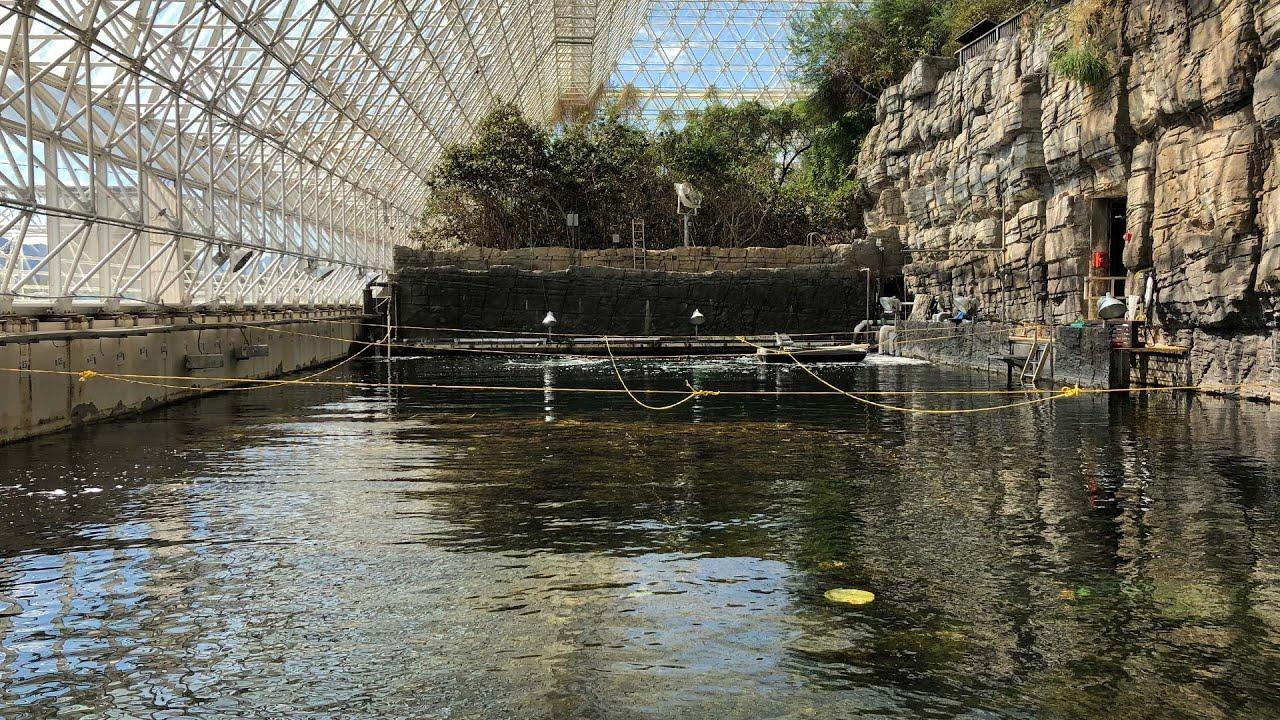
The name itself was a statement of intent. Earth was Biosphere 1. This was meant to be Biosphere 2: a closed ecosystem that could teach us how the real world works by forcing every hidden connection into plain view. Inside the structure sat multiple biomes, including rainforest, savannah, desert, wetland, ocean, coral reef, and an agricultural zone built to feed the people living there. It was part science, part systems theory, part utopian theatre, and far too expensive to fail quietly.
The project was funded by billionaire Ed Bass and driven by a sprawling, eccentric vision associated with John Allen and the Institute of Ecotechnics. That mix of money, ideology, ecology, and spectacle gave Biosphere 2 its strange electricity. It did not feel like a sober lab experiment. It felt like a full-scale attempt to rehearse the future.
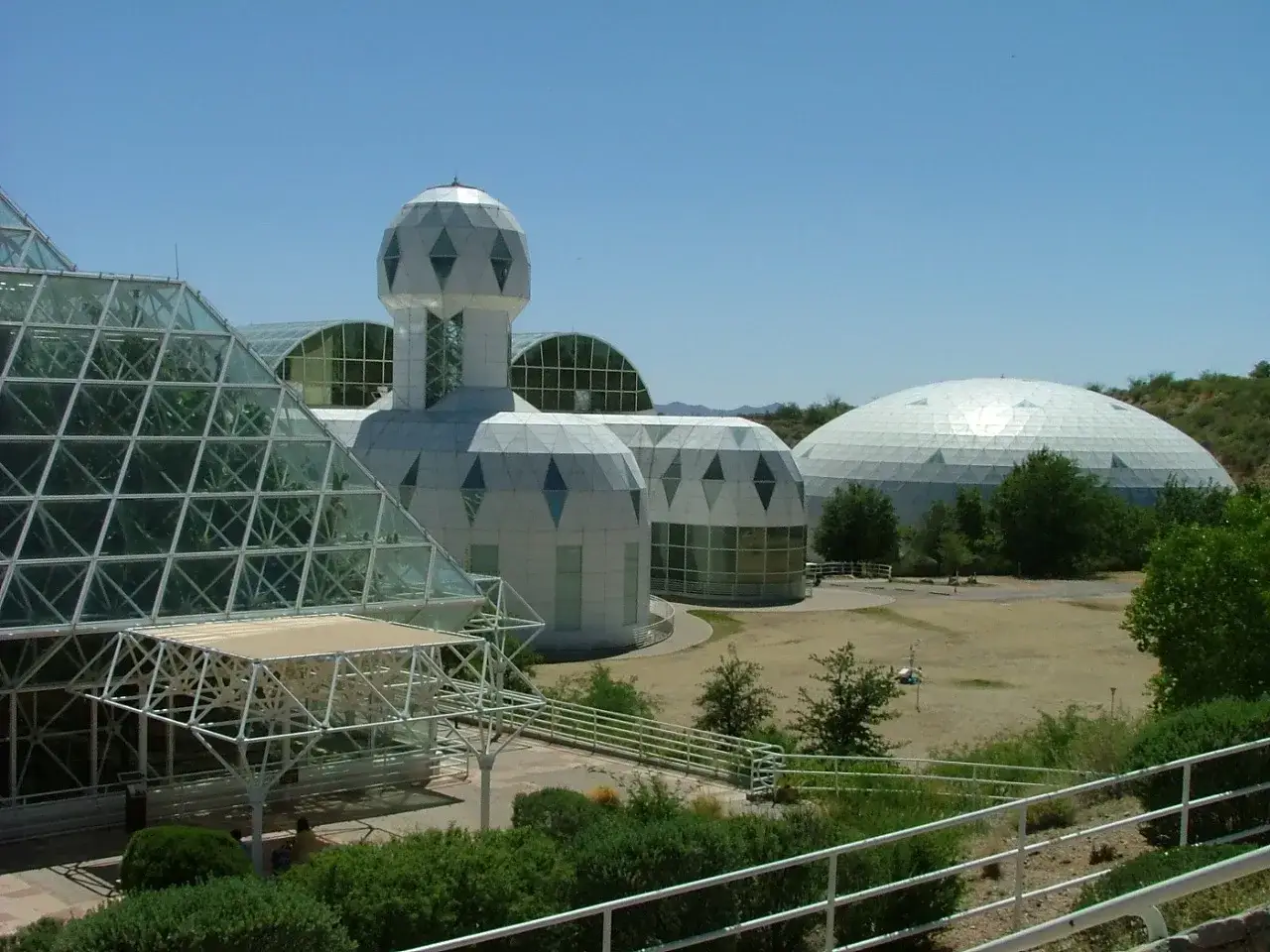
A vast glass-and-steel Biosphere 2 rising from the Arizona desert at sunrise, with domes gleaming against dry mountains
From the start, the ambition bordered on lunacy in the best and worst possible ways. This was a sealed world that needed its own atmosphere, its own agriculture, its own environmental balance, and a structure strong enough to survive Arizona’s brutal temperature swings. Even the building had lungs: giant pressure-regulating chambers designed to keep the whole thing from cracking itself apart as the air inside expanded and contracted.
Inside Biosphere 2, a Perfect System Refused to Behave
The idea sounds clean on paper. Build the world. Close the door. Let the system run. But ecosystems do not care about paper. They care about balance, chemistry, light, microbes, species interactions, and all the tiny processes humans routinely forget until those processes turn around and bite them.
Inside Biosphere 2, the biospherians worked constantly to keep their world alive. They grew wheat, rice, beans, sweet potatoes, papayas, bananas, and other crops in a high-efficiency farming system that became astonishingly productive for its size. They kept goats for milk, hens for eggs, and lived with the daily reality that every calorie, every task, and every fluctuation in the atmosphere mattered.
The trouble was that the system would not behave. Weeds and pests arrived as stowaways. Some species flourished too much, others not enough. Pollination faltered. Food production lagged behind what the crew needed. Even at remarkable levels of efficiency, they were still coming up short. Hunger became part of the experiment’s texture. So did exhaustion. So did the creeping feeling that a sealed paradise can become a pressure cooker very quickly.
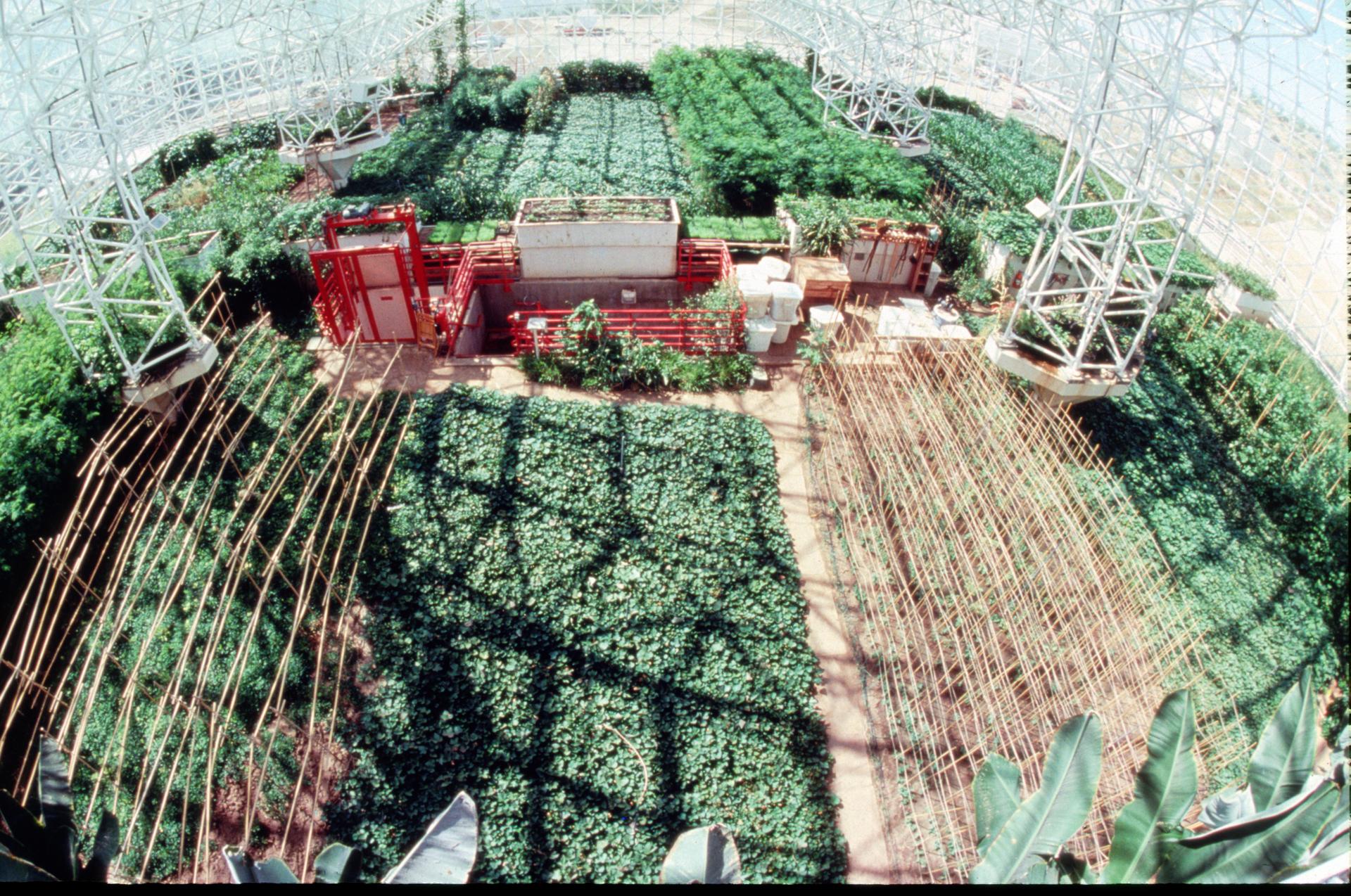
harvesting crops beneath the glass, surrounded by dense plants, tools, and humid filtered light
That is one of the reasons Biosphere 2 still fascinates. It was not a failure because people stopped trying. It was almost the opposite. The people inside worked obsessively. The system kept reminding them that effort alone is not the same thing as control.
Why Did Biosphere 2 Fail, or Seem To?
The question many people still ask is simple: why did Biosphere 2 fail? The more honest answer is messier. The project did not collapse in one dramatic instant. It deteriorated through a series of interconnected problems, many of which looked small until they were not.
The most famous of these was the oxygen crisis. Over time, oxygen levels inside the sealed environment began to fall. That made the people inside weaker, slowed work, and pushed the whole experiment toward a dangerous threshold. Later analysis pointed toward a hidden chemical trap inside the structure itself, including the effect of untreated concrete and other material interactions within a closed system. Biosphere 2 had not simply run out of air in a cinematic way. It had become a lesson in how a closed ecosystem can absorb, shift, and destabilise the very conditions meant to sustain life.
At the same time, food shortages made everything harder. Lower energy meant less labour. Less labour meant more strain on farming and maintenance. Atmospheric imbalance affected crops. Crop stress affected morale. Morale affected how the group functioned. The whole point of the project was to expose interconnectedness, and it certainly did that. It just did so by making every weakness drag on every other weakness.
Then came the public version of the story.
The Biosphere 2 Experiment Became a PR Bloodsport
Biosphere 2 was an irresistible media target. It was expensive, strange, slightly mystical, scientifically grandiose, and full of people living under glass in the desert while promising to help humanity colonise other planets. The press did not merely observe it. In the telling here, it often reduced it to spectacle, vanity, or fraud.
That mattered. Once the project was mocked, every technical intervention risked being seen as cheating rather than experimentation. A backup system stopped looking like engineering foresight and started looking like proof of deception. A practical survival decision became a headline problem. In that environment, public image did not sit outside the science. It distorted the science from the outside in.
One of the bleakest parts of the story is that fear of backlash appears to have delayed sensible action. A carbon dioxide scrubber had always been part of the system design, yet hesitation around optics became part of the crisis. Oxygen had to be added. Critics treated that as disqualifying. But for a closed-world experiment meant to teach humans how to survive beyond Earth, using available life-support mechanisms was not evidence that the idea was worthless. It was evidence that real survival systems require intervention.
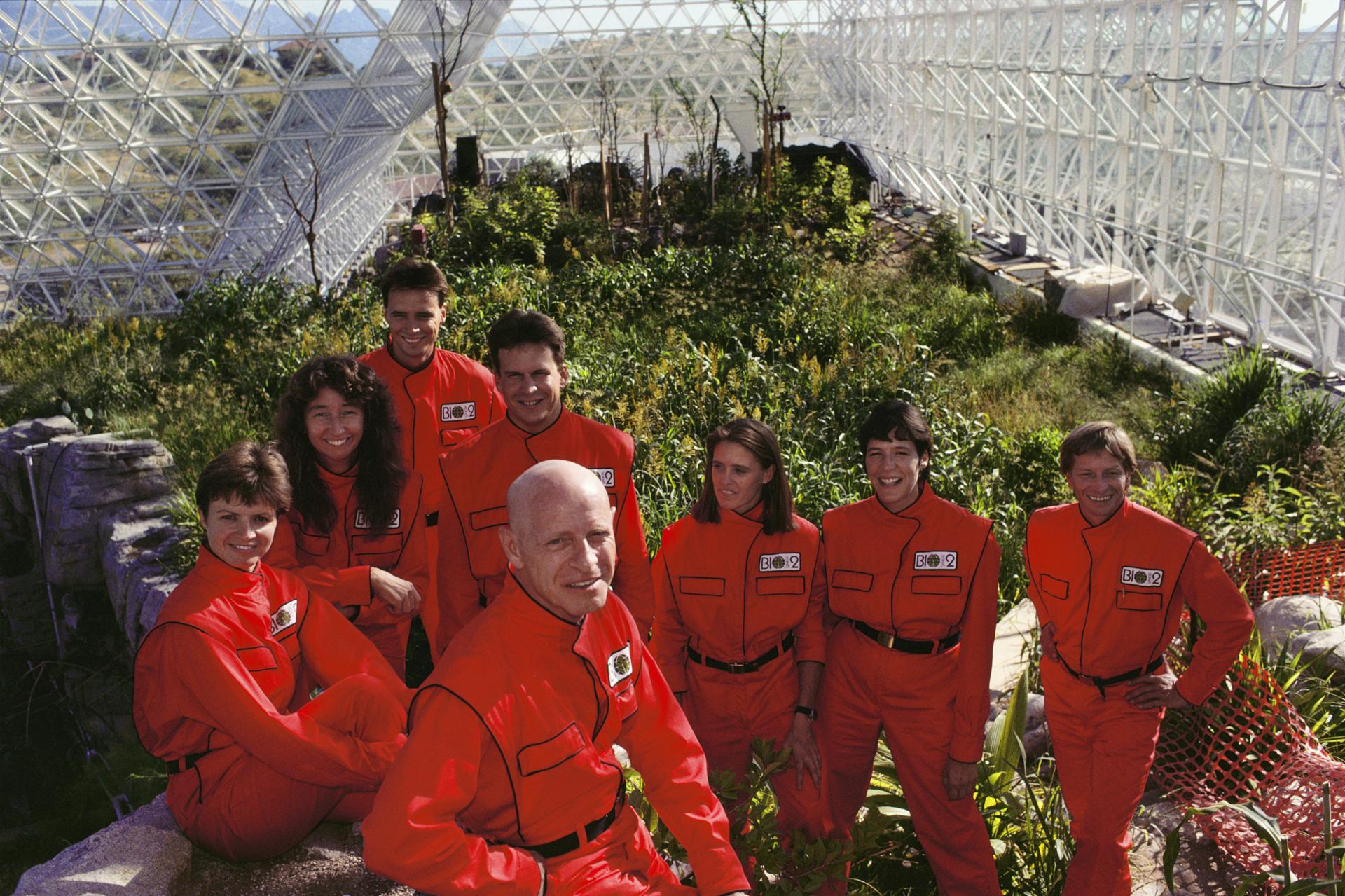
The biospherians, as they liked to call themselves.
The experiment did not just have to survive ecology. It had to survive narrative.
What Happened in Biosphere 2 After the First Mission
The first two-year mission ended, battered but still historically remarkable. The inhabitants had stayed inside for the full duration, even as oxygen dropped, crops underperformed, and the outside world circled like vultures. That should have counted for more than it usually does.
Instead, later conflict deepened the damage. Management battles intensified. Leadership changed hands. The project’s internal trust fractured. In the second phase, decisions made from outside the glass undermined confidence and, ultimately, the experiment itself. Once the structure was breached and the atmosphere exchanged with the outside world, the symbolic power of the sealed system was broken too.
Yet even then, Biosphere 2 did not vanish into pure farce. The facility went on to support serious ecological research. More importantly, the original experiment revealed things that only a sealed world could reveal. It showed how sensitive closed systems are to construction materials, soil processes, atmospheric chemistry, and biological imbalance. It highlighted the importance of buffer zones and ecological relationships that are easy to overlook on a full-sized planet. It turned systems thinking from abstraction into lived reality.
That is why Biosphere 2 endures. Not because it proved humans were ready to build a second Earth, but because it demonstrated just how difficult that dream really is. It stripped away the fantasy version of planetary engineering and replaced it with something more useful: humility.
Listen for the Full Biosphere 2 Story
The full Biosphere 2 story carries more tension, absurdity, and human texture than any short article can hold. Listening adds the pressure of the countdown, the social weirdness, the media hostility, and the slow realisation that this experiment was not just about a dome in Arizona, but about how fragile any world becomes when every system is connected.
Listen to the linked episode
Related episodes
The Acali Experiment: Science, Sex, and Santiago Genovés’s Bizarre Human Behaviour Study
In this episode of the Compendium, we explore the Acali Experiment—a 1973 voyage where anthropologist Santiago Genovés set sail with ten strangers to study human behavior. Dubbed the "Sex Raft" by the media, his 101-day Atlantic crossing aimed to investigate the roots of violence and sexuality. Despite Genovés's attempts to incite conflict, the crew's resilience challenged his expectations. This journey not only ques...
Oceangate Titan Disaster: A Billionaire’s Dive into Hubris, History, and Horror
In this episode of the Compendium, we’re exploring the Oceangate Titan disaster—a chilling tale of ambition, oversight, and tragedy. On June 18, 2023, the Titan submersible imploded during a descent to the Titanic wreck, claiming the lives of all five aboard, including OceanGate CEO Stockton Rush. Despite prior warnings about the sub's carbon-fiber hull and safety concerns, the expedition proceeded, leading to catast...
Space Cadets: How A British Reality Show Convinced Contestants They Were In Space
A reality show convinces its contestants they’ve been launched into space, creating one of the strangest deceptions in British television history. This episode revisits Space Cadets, the 2005 Channel 4 hoax that used fake cosmonaut training, a shuttle simulator, and an entire “Russian base” built in Ipswich to sell an impossible illusion. We explore how the production pulled it off, why the contestants believed it, a...
Balloonfest: Clevelands 1986 Float-tastrophe of Epic Proportions
In this episode of the Compendium, we step back into time to revist The Cleveland Balloon Fest of 1986, a high-flying event that hoped to lift a city's spirits but instead spiraled into one of the most infamous blunders of the decade. I tell Adam all the juicy details of this helium-filled fiasco, where ambition met reality with explosive environmental consequences. We'll explore how this well-intentioned charity eve...
Related posts

True Crime
Morgan Metzer: The True Story Behind Gaslit by My Husband
Morgan Metzer survived what looked like a random home invasion, only for the truth to reveal something far more chilling. This is the real story behind Gaslit by My Husband - a case of coercive control, gaslighting, and psychological abuse that ended in a staged act of terror.
Read post
True Crime
Lucy Letby: What Really Happened?
This article is a factual Lucy Letby case explainer focused on timeline clarity, court context, and the core questions readers are trying to understand.
Read post
True crime
The Unsolved Mystery of Jennifer Fairgate The Woman with No Past
This guide explains the Jennifer Fairgate mystery for readers seeking a clear timeline, verified evidence, and the strongest theories still debated today.
Read postJoin the Patreon
Get ad-free listening, early access, bonus archive drops, and your private RSS feed without switching apps.