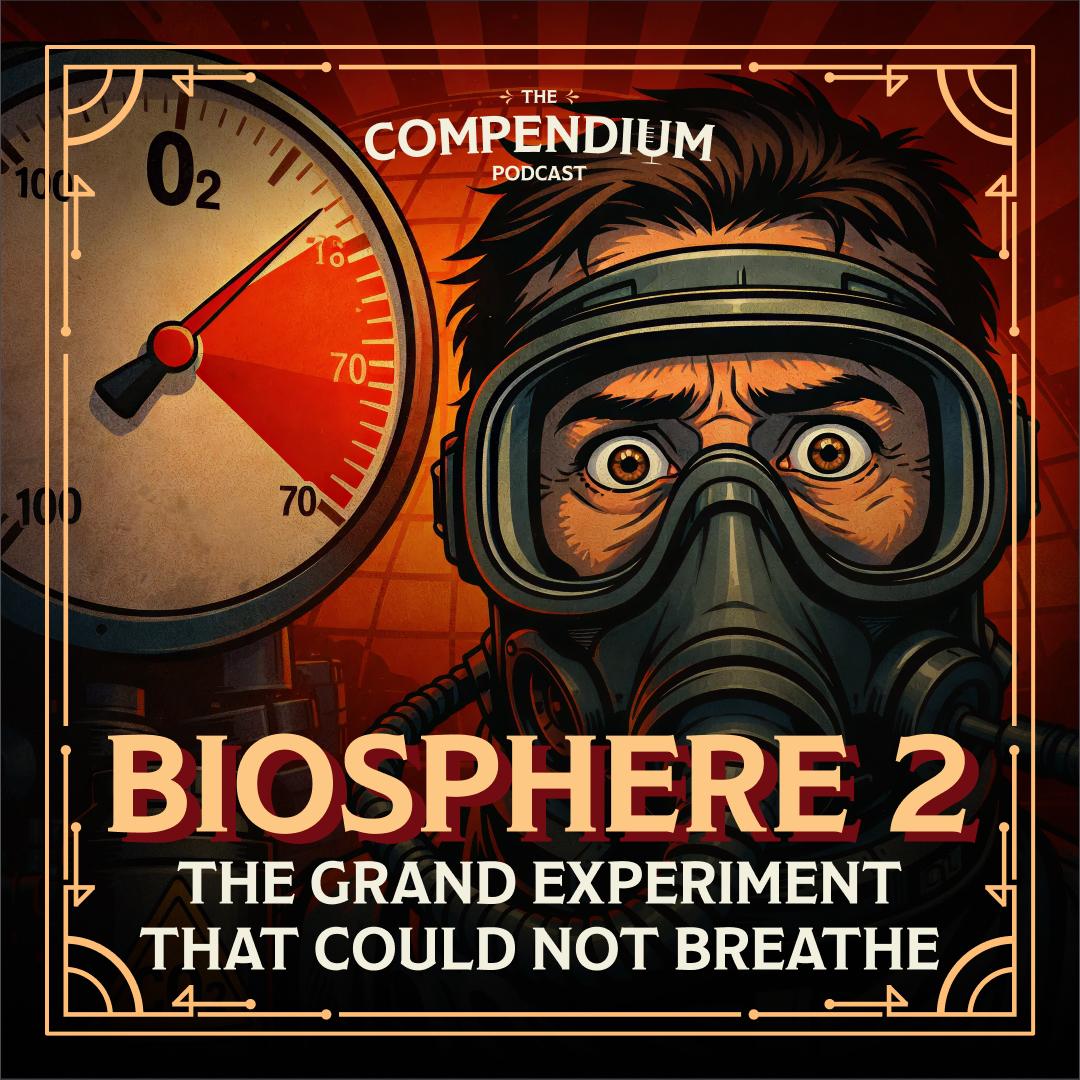
The mission began on 26 September 1991, when eight Biospherians were sealed inside the glass facility in Oracle, Arizona, to test whether a materially closed ecosystem could support human life and eventually inform space-colony research.
What followed was not the clean triumph the project promised. Oxygen levels dropped from about 20.9 percent to 14.2 percent over roughly 17 months, carbon dioxide swung sharply, farming proved harder than advertised, and the experiment became notorious for stress, scrutiny, and internal fracture as much as for science.
This episode examines what Biosphere 2 actually was, what went wrong inside it, and why reducing it to a punchline misses the more interesting truth. However flawed the missions were, they exposed how absurdly difficult it is to replicate Earth’s life-support systems, and the site later evolved into a University of Arizona research facility studying climate, ecology, and controlled environments.
What Happened in the Biosphere 2 Experiment?
Biosphere 2 was built in Oracle, Arizona, as a vast sealed facility meant to model a self-sustaining world. The idea was ambitious to the point of faintly deranged: recreate key ecosystems, add agriculture and human living quarters, and see whether people could survive inside a materially closed environment that might one day inform life beyond Earth.
The first major mission began on 26 September 1991, when four men and four women sealed themselves inside. They were expected to grow food, manage the internal ecosystems, record scientific data, and live off the system they had built. In theory, it was a rehearsal for humanity’s future in hostile environments. In practice, Earth turned out to be doing rather a lot of invisible work.
Within months, the atmosphere inside the structure began to drift. Oxygen levels fell while carbon dioxide fluctuated dramatically. Later explanations pointed to intense soil microbial activity consuming oxygen, while excess carbon dioxide was absorbed by unsealed concrete in the structure. At the same time, food production was difficult, some species died off while others boomed, and crew tensions became part of the story the public could not stop staring at.
A second closure mission began in 1994, but it lasted only about six months before management turmoil helped bring it to an early end. Even so, the project did not simply vanish. After years of changed ownership and direction, Biosphere 2 became a University of Arizona research site, where the sealed dream was replaced by something less utopian and more useful: controlled Earth-systems science.
Why This Story Matters
Biosphere 2 matters because it exposed a humbling fact that still feels timely: humans are very good at underestimating the complexity of the systems keeping us alive. The experiment was sold as a controlled miniature Earth, but the atmosphere, soil chemistry, food webs, and human dynamics refused to behave like obedient components in a neat machine.
That is exactly why the story survives. It sits at the intersection of climate science, ecological engineering, space-habitat design, and plain old human hubris. And for all the mockery it attracted, the site’s later research life suggests the project was not merely a spectacular misfire. It was also an expensive, oxygen-starved reminder that Earth is not easy to copy, replace, or outsmart.
What You’ll Hear in This Episode
In this episode, you’ll hear how Biosphere 2 was built, why the sealed mission began to unravel, what caused the oxygen crisis, and why the experiment still matters far beyond its old punchline status.
Topics Include
- The original aim of Biosphere 2 and the space-colony idea
- The eight Biospherians and the 1991 seal-in
- Falling oxygen, carbon dioxide swings, and food pressure
- How soil microbes and unsealed concrete helped destabilise the system
- Media backlash, management conflict, and the shortened second mission
- How Biosphere 2 became a University of Arizona research facility
Resources and Further Reading
- Biosphere 2 - Wikipedia
- Life under the bubble - Discover magazine
- The Human Experiment - by Jane Poynter
[00:00:01] Kyle Risi: Right Adam If we do irreversible damage to our planet what does humanity do? More importantly, where the hell do we go?
[00:00:11] Adam Cox: Uh, well, don't they say Australia's a good place to go?
[00:00:13] Kyle Risi: Let's, for this experiment, assume that Australia is gone.
[00:00:16] Adam Cox: Sorry Australians.
[00:00:18] Kyle Risi: Yeah. Bye.
[00:00:19] But what have I told you, Adam, that in Arizona in 1991, a team of scientists set out to study the feasibility of digging a vast three hectare [00:00:30] terrarium fully sealed and closed off from the outside world.
[00:00:33] the purpose. Was to better understand how we might build a fully enclosed environment on another planet like Mars,
[00:00:40] so today on the compendium I'm gonna tell you about this incredible experiment called Biosphere Two
[00:00:49] And this is a wild story, not only because of the science at the heart of it, but also something very familiar to us , on this podcast, the villainy of the media. their [00:01:00] agenda ended up driving a deep sense of misunderstanding and misrepresentation into the story.
[00:01:06] So there will be times where you'll be like, hang on a minute.
[00:01:08] That doesn't sound like the biosphere story that I've heard. And you'll be right.
[00:01:12] Adam Cox: because We are lying.
[00:01:13]
[00:01:38] Kyle Risi: Welcome to the Compendium, an Assembly of Fascinating things, a weekly variety podcast that gives you just enough information to stand your ground at any social gathering.
[00:01:49] Adam Cox: We explore stories from the darker corners of true crime, the hidden gems of history, and the jaw dropping deeds of extraordinary people.
[00:01:55] Kyle Risi: I'm, of course, Kyle Reese, your ringmaster for this week's episode.
[00:01:59] Adam Cox: And I'm [00:02:00] Adam Cox, the fire eater Fireman for this week.
[00:02:05] Kyle Risi: hang on. So you are eating the fire and then you burst into flames, but then you're also the fireman, so you have to stay calm and composed and then you've gotta put yourself out.
[00:02:14] Adam Cox: No.
[00:02:15] Kyle Risi: Oh,
[00:02:15] Adam Cox: that's a nice idea. I'll think maybe I'll use that one for next week. No, the fire readers, in case they accidentally catch a light, I'm there with a fire extinguisher. Oh. Ready to put them out.
[00:02:25] Kyle Risi: Ah, that's quite boring.
[00:02:26] Adam Cox: Well,
[00:02:27] Kyle Risi: you're just a guy on the sideline. I thought you'd be just more [00:02:30] imaginative than that, Adam.
[00:02:31] Adam Cox: Well, in fairness, I, you know, I get a bit anxious and I accidentally like spray them When they don't need to be sprayed.
[00:02:36] Kyle Risi: It's like on the ready. They could, they could blow up in any second.
[00:02:39] Adam Cox: Exactly.
[00:02:40] Kyle Risi: I see.
[00:02:40] Adam Cox: So I have ruined the show multiple times.
[00:02:43] Kyle Risi: Just covered in white foam. So stupid. Guys, if you are new to the show and you wanna support us, 'cause we absolutely hope you do wanna support us, then you can do so by joining our Patreon where you can get access to exclusive perks including next week's episode a whole seven days before [00:03:00] anyone else.
[00:03:00] Adam Cox: And for as little as $5 a month, you can become a fellow freak of the show, which will unlock our entire back catalogue of all of our classic episodes
[00:03:09] Kyle Risi: we've given up. Kind of just saying what they are.
[00:03:11] Adam Cox: Nah. Yet. Go find out.
[00:03:12] Kyle Risi: Go, go. Have a look. Look. But honestly Adam, really the best reason to sign up as a certified freak or a big top tier member is that you get exclusive access to our compendium key chain.
[00:03:24] It's like a gem hanging down, you know, right there near your [00:03:30] crotch
[00:03:30] Adam Cox: or I was thinking if you buy yourself an extra one
[00:03:32] Kyle Risi: mm-hmm
[00:03:32] Adam Cox: You get a nice pair of earrings.
[00:03:34] Kyle Risi: Yeah.
[00:03:34] Adam Cox: Butcher earrings.
[00:03:36] Kyle Risi: Or you could be, if you want 'em to be like balls, then you've got two balls rather than like being like Hitler, just having one ball, you know?
[00:03:41] Adam Cox: Yeah. Then you're not like running around in a circle. '
[00:03:45] Kyle Risi: cause famously, if you ever see a guy running around in a circle in the street, it's just go one ball.
[00:03:49] Adam Cox: Yeah.
[00:03:50] Kyle Risi: He's imbalanced.
[00:03:51] Adam Cox: That's science.
[00:03:52] And lastly, guys, please follow us on your favourite podcast app and leave us a review. 'cause your support helps others find us and keeps these amazing [00:04:00] stories coming.
[00:04:00] Kyle Risi: Right Adam, that is enough of the housekeeping.
[00:04:02] because today on the compendium we're diving into an assembly of science under pressure where survival fixes become PR disasters.
[00:04:12] Adam Cox: Okay. Feels like some kind of experiment.
[00:04:15] Kyle Risi: Mm-hmm. Yes it is actually.
[00:04:17] But I think it is fair to say that we are living in a very scary time for humanity right now would you say?
[00:04:22] Adam Cox: Yeah. There's been better periods.
[00:04:24] Kyle Risi: Been better periods. I've had a better period. This one's been heavy.
[00:04:29] Adam Cox: Well, I think [00:04:30] that the naughties and the tens, it felt like everything was fine.
[00:04:33] Kyle Risi: Yeah. And then bloody COVID hit and then bam.
[00:04:35] To be fair, as millennials, we've just been fucked One. Decade after the next decade. After the next decade. I
[00:04:40] Adam Cox: feel like every generation will say that.
[00:04:42] Kyle Risi: Do you reckon? I think millennials more, more so. But anyway, Adam, there's obviously a lot of political egos, peacocking on the global stage are pissing each other off.
[00:04:50] And the terrifying thing is that these are the kind of figures who, if you press right buttons can the future of our species on this planet, it feels like the threat, [00:05:00] especially now of nuclear war, is literally just around the corner.
[00:05:04] So much so that in January, 2026, the Science and Security Board updated the doomsday clock from 89 seconds to midnight to 85 seconds.
[00:05:13] Which brings us to a very important question, Adam. If we do irreversible damage to our planet or our climate, or if we spark nuclear war that plunges us into a nuclear winter, what.
[00:05:25] Does humanity do? More importantly, where the hell do we go?
[00:05:29] Adam Cox: [00:05:30] Uh, well, don't they say Australia's a good place to go?
[00:05:32] Kyle Risi: Okay. Let's, for this experiment, assume that Australia is gone.
[00:05:36] Adam Cox: Okay.
[00:05:36] Kyle Risi: As much as we love them.
[00:05:37] Adam Cox: Sorry Australians.
[00:05:38] Kyle Risi: Yeah. Bye. I mean, if Australia is just about to be gone, we're definitely gone.
[00:05:42] Adam Cox: Yeah.
[00:05:42] Kyle Risi: Now, there is a popular idea that we could colonise potentially another planet.
[00:05:45] Adam Cox: Yeah. And I guess, is that what Elon is trying to sort out for us?
[00:05:49] Kyle Risi: Yeah. Elon Musk has been very vocal about the theoretical possibilities of terraforming Mars.
[00:05:55] By essentially nuking the poles that will send CO2 and water vapour into [00:06:00] the atmosphere will thicken it up into something that could potentially sustain human life.
[00:06:04] But Adam, the reality is that right now we are nowhere close to having that technology to Terraform and entire planet.
[00:06:11] And while Elon Musk might be one of the loudest proponents of this being possible, he hasn't so far invested a single fucking dollar into even exploring that possibility.
[00:06:22] Because of course, as we know, there's no money in that for him Even governments around the world, they're so focused on the short term, they can't even think [00:06:30] about humanity's future.
[00:06:31] Do you know what I mean?
[00:06:32] Adam Cox: Yeah, yeah, yeah.
[00:06:33] Kyle Risi: They're barely thinking 10 years. So right now our options for survival in the event of a nuclear holocaust are very slim, like billionaires and governments, they have bill bunkers, right? So they do exist. I think it's a guy called Peter Thiel. He's, apparently has an underground bunker ready to go in New Zealand.
[00:06:52] But Adam, you'd be kidding yourself. If you think even for a second that anyone other than the global elite have a spot in one of those bunkers, right?
[00:06:59] Adam Cox: [00:07:00] Yeah. Although, I'm sure I did hear that RuPaul was trying to build something.
[00:07:06] Kyle Risi: No. What? Just drag queens.
[00:07:07] Adam Cox: I'm sure
[00:07:09] Kyle Risi: I want to be in that bunker.
[00:07:10] Adam Cox: Well, we need entertainment.
[00:07:14] I swear. Like he was like, do you know what? The world's not great. He's gonna like build a house somewhere. And I just got the idea that he's gonna put a bunker with it.
[00:07:21] Kyle Risi: Did he say the words bunker?
[00:07:23] Adam Cox: I wanna say yes. He basic, he definitely alluded to the fact this is where he was gonna be hanging out if the world goes to [00:07:30] shit.
[00:07:30] Kyle Risi: Great. I wanna be in their house.
[00:07:32] Adam Cox: It'll just be him and Michelle Visa.
[00:07:35] Kyle Risi: Oh God. you can literally just put Michelle Visage outside, like, she is not being killed. She's like a cockroach.
[00:07:40] Adam Cox: She's like Cher and Cockroach. They're out doing the gardening.
[00:07:43] Kyle Risi: Yeah. She's the only one who can go do the beer run.
[00:07:46] But also the, the idea of living inside, let's say a concrete bunker. do you wanna live the rest of your life in one of those?
[00:07:52] I've never been able to feel grass, never swimming in the ocean again. Not even getting to like, I don't know, pet a pig.
[00:07:59] Adam Cox: [00:08:00] Yeah. It's pretty awful.
[00:08:01] Kyle Risi: I'd rather just, this is it. It's time for us to die.
[00:08:04] Adam Cox: Yeah.
[00:08:04] Kyle Risi: But what have I told you, Adam, that in Arizona in 1991, a team of scientists set out to study the feasibility of digging a vast three hectare terrarium fully sealed and closed off from the outside world, complete with its own rainforest deserts. Mangroves, and even an ocean with coral reef.
[00:08:25] Adam Cox: Well, what's the purpose of all that?
[00:08:27] Kyle Risi: the purpose. Was to basically better [00:08:30] understand how we might build a fully enclosed environment on another planet like Mars, But also to understand how our environment works And what they learned very quickly is that the environment isn't just a stage for us to exist on. It's essentially a living system like we already know today. Like how everything is interconnected. But back then, this was only something that they were starting to understand.
[00:08:51] The planet is a collection of tightly coupled loops where seemingly insignificant changes in, let's say for example, the desert can [00:09:00] ricochet and have an effect in the rainforest 5,000 miles away,
[00:09:04] like tiny imbalances in like carbon or soil biology and atmospheric chemistry. They don't stay tiny, right? They also end up compounding over time and eventually they cascade.
[00:09:16] And once the whole system is pushing and pulling on these same chords, outcomes become almost impossible to predict.
[00:09:23] And so Adam, today on the compendium, I'm gonna tell you about this incredible experiment that [00:09:30] was undertaken in 1991 called Biosphere Two
[00:09:35] Adam Cox: Two. You mean there's a sequel? This is the sequel to Biosphere One.
[00:09:38] Kyle Risi: Actually, the reason why it's called Biosphere two is because biosphere one is earth. Oh yeah. So there wasn't a, a bioo one that went tragically wrong.
[00:09:49] Adam Cox: Um, but I vaguely know something about this because wasn't there a group of people it looked like a giant greenhouse? Yes. Or like a crystal MAs dome.
[00:09:56] Kyle Risi: Yes, correct. A giant greenhouse.
[00:09:59] Adam Cox: Yeah.
[00:09:59] Kyle Risi: [00:10:00] Is a great way of putting it.
[00:10:01] Adam Cox: But I don't really remember what happened once they went in.
[00:10:04] Kyle Risi: Adam. This is a wild story, not only because of the science at the heart of it, but because of the very human tale that surrounds it, but also something very familiar to us on this podcast, the villainy of the media.
[00:10:17] Adam Cox: Oh, they're always out at those, those media,
[00:10:19] Kyle Risi: those pesky kids,
[00:10:20] Adam Cox: journalists and photographers,
[00:10:22] Kyle Risi: because their agenda ended up driving a deep sense of misunderstanding and misrepresentation into the story.
[00:10:29] So for our [00:10:30] listeners who have heard this story before, there will be times where you'll be like, hang on a minute.
[00:10:34] That doesn't sound like the biosphere story that I've heard. And you'll be right.
[00:10:38] Adam Cox: We are lying.
[00:10:39] Kyle Risi: Yes. No, it's because at the time the media, had you believe that this experiment was a complete and utter failure. Right.
[00:10:47] That is the overall message that a lot of people will take away from the story.
[00:10:50] That it just went to shit. And while yes, there were mistakes, the press misrepresented the goal of the experiment.
[00:10:57] And so somewhere in that [00:11:00] mistranslation, they became hellbent on framing this story as something that it wasn't.
[00:11:05] So when we searched in the story, I had to really fight really hard to treat a lot of the media reporting on the story with a degree of suspicion.
[00:11:13] And that's the thing, like when people go and like research the story, what they're researching is the reporting from the press, right? And because it's from the press, they go, oh, this is, this is gospel, right? but actually the press were against this from the very beginning.
[00:11:26] Adam Cox: Why?
[00:11:27] Kyle Risi: It's kind of like a, a mistrust thing, but started from a [00:11:30] misunderstanding and then that's what stayed on the record.
[00:11:32] Adam Cox: I see.
[00:11:33] Kyle Risi: So it's tricky.
[00:11:34] Adam Cox: So basically don't read a Daily Mail article, read Wikipedia.
[00:11:37] Kyle Risi: I mean, I even found bloody articles from The Guardian that were re representing the story. Ah. So it's tricky. And you can't take that back, right? It's like tube or toothpaste. Squeeze it out. You can't put that back in the tube. It's out there.
[00:11:50] Adam Cox: I've never tried putting toothpaste back in the tube.
[00:11:52] Kyle Risi: It doesn't work here to tell you.
[00:11:55] So, Adam, today there are a few myths that we'll be busting, but don't get me wrong, the experiments [00:12:00] was cancelled. So you could argue that it was a failure in that sense. But a lot of that was the media's doing.
[00:12:05] Adam Cox: So it did get up and running.
[00:12:07] Kyle Risi: Mm-hmm.
[00:12:07] Adam Cox: But it was cancelled midway through.
[00:12:09] Kyle Risi: Yeah. On phase two. And we'll go through that because once they turned against biosphere two, the experiment's failure sort of became this self-fulfilling prophecy.
[00:12:17] It ended up infecting kind of the project's ethos, which ended up fueling a bunch of infighting and power struggles and very silly decisions ended up being made in the process of this [00:12:30] experiment.
[00:12:30] And so, Adam, today on the compendium, I'm gonna tell you about the incredible experiment that was Biosphere two.
[00:12:35] And hopefully, I'll tell you something you perhaps did not know about the story.
[00:12:40] Adam Cox: Alright. You've sold me. What is this experiment all about?
[00:12:43] Kyle Risi: Okay. So as we always do at the start of every episode, we need to meet the people behind it, right?
[00:12:48] Adam Cox: Yes. Who was it? Who was pioneer? When were
[00:12:51] Kyle Risi: they born?
[00:12:51] Adam Cox: Yeah, when were they born? When, when were they porn?
[00:12:53] Kyle Risi: When were they porn?
[00:12:54] Adam Cox: When, where did they grow up? What was wrong with their parents?
[00:12:57] Kyle Risi: Okay, so let's start with a guy who funded the entire [00:13:00] thing.
[00:13:00] Adam Cox: Uhhuh.
[00:13:00] Kyle Risi: He's a billionaire of course, and his name is Ed Bass.
[00:13:04] His family made their fortune in oil down in Texas, and like a lot of rich kids, it ends up taking the Ivy League route, when it comes to his education, he ends up attending Yale University where he graduates with a degree in administrative science.
[00:13:18] After that. In the early 1970s, he decides that he wanted to pursue a master's degree in architecture, but this doesn't really end up working out well for him.
[00:13:27] And so as many kids did, especially in the [00:13:30] seventies. He decides to drop out and he decides to go off to find himself.
[00:13:34] Adam Cox: Does he have a guitar?
[00:13:35] Kyle Risi: He's got a guitar.
[00:13:36] Adam Cox: I knew it.
[00:13:37] Kyle Risi: Yeah. But also it's a very interesting time. 'cause remember this is the seventies, right? This is a period where all across America, people were exploring new OG ways of thinking. We've covered a few episodes on the show and they're mostly, cults.
[00:13:51] Adam Cox: Cults and hippies.
[00:13:52] Kyle Risi: So this was a period where communes and cults were popping up everywhere, which we know there is often a very fine line between the two, [00:14:00] right. And that's important to our story. You hear commune, people typically think cult,
[00:14:05] Adam Cox: Mm-hmm.
[00:14:06] Kyle Risi: It's also the decade they gave us subcultures like the Rajni and his Oregon sex cult. You also have the ESE liberation army. Do you remember that one?
[00:14:14] Adam Cox: Mm-hmm.
[00:14:15] Kyle Risi: The famously, they abducted Patty Hearst, who keeps popping up in our episodes. Did we not do one with HH Holmes, the Randolph Hearst, who owned the paper at the time, that's Patty Hearst's grandfather.
[00:14:27] Adam Cox: Oh yeah, you did say about that.
[00:14:28] Kyle Risi: Yeah. Yeah. And they, she keeps popping [00:14:30] up. You also got the Black Panthers, which I wouldn't call them a cult, but they were more of a subculture, and they did have a commune, but either way, wherever you looked, there was a new subculture that was taking shape somewhere in America.
[00:14:41] And among one of those subcultures is one that you probably never heard of, and they were called.
[00:14:47] Synergy and they operated out of a commune just outside Santa Fe, in New Mexico.
[00:14:53] Adam Cox: Synergy as in like synergy.
[00:14:55] Kyle Risi: Yes, exactly.
[00:14:56] Adam Cox: I see
[00:14:56] Kyle Risi: The commune itself was an experiment. Seeing how [00:15:00] ecotechnics, this idea of harmonising technology, ecology and human ingenuity could come together to build a self-sustaining community.
[00:15:08] They grew their own food. They used new forms of synthetic fertilisers. They experimented with hybrid crops that were able to kind of survive more harsher climates, maybe in the desert or in Africa, et cetera. They also source their own energy. Again, experimenting with different technologies. Basically.
[00:15:25] There was a lot of science going on there, rooted in anthropological and ecological [00:15:30] ideologies, right? Mm-hmm. They sound great, right? A bunch of hippie scientists
[00:15:33] Adam Cox: sounds idealistic almost.
[00:15:35] Kyle Risi: Yes.
[00:15:36] And so, as you can imagine, synergy attracted academics from all over the world, and because it was full of like-minded people, it became a, potent hotbed for ideas and new ways of thinking.
[00:15:47] Just be clear.
[00:15:48] While some people did live there permanently it wasn't a situation where you were trapped or like this is where you lived. Right. It was more like a retreat, scientists and academics could just come and go as they please. They would then be [00:16:00] working over like in China, and then when they get back to America, they'd pop into kind of see all their mates that were there.
[00:16:06] Adam Cox: Yeah. It's not like they've got, I don't know, watchtowers with people with sniper rifles.
[00:16:10] Kyle Risi: Yeah, exactly.
[00:16:11] And one of the key features of Synergy, and again, this will become very important to our story, is that it featured a Buckminster Fuller geodesic dome that doubled up as a theatre that they called the Theatre of all possibilities.
[00:16:24] And it's exactly that. It's, when I say theatre, I mean imagine a bunch of theatre kids, right?
[00:16:29] Adam Cox: Show [00:16:30] tunes.
[00:16:30] Kyle Risi: Exactly.
[00:16:30] Adam Cox: Tap dancing.
[00:16:31] Kyle Risi: And they use this to rehearse performances for their wandering performance troupe, trying to teach people new ways of living sustainably through technology. They'd host or visit various scientific conferences where you could expect a performance as part of it.
[00:16:46] Adam Cox: I love learning through song.
[00:16:48] Kyle Risi: Exactly.
[00:16:49] This is the point of it. Right? They're not theatre kids, they're just like, it's just something that they did as well. Right.
[00:16:54] Adam Cox: It's like adult Sesame Street.
[00:16:55] Kyle Risi: And just be clear as well, not everyone was involved in the theatre side of things. It's like how [00:17:00] your gym might offer a yoga class. It doesn't mean that you're a yoga obsessed.
[00:17:04] Adam Cox: Yeah. So it's just one of the things that they do and that they offer.
[00:17:07] Kyle Risi: but It's also one of their USPS where they can kind of showcase new ways of learning how to be sustainable or showcasing some of their technology, through the, the arts or performance, Adam
[00:17:16] Adam Cox: Mime
[00:17:17] Kyle Risi: through Mime.
[00:17:18] Yes. That might have been one of the things they did. Yeah.
[00:17:21] Now the head of Synergy is a man called John Allen. The plainest name you could possibly even think of.
[00:17:26] Adam Cox: That's like two ma male names.
[00:17:28] Kyle Risi: Yeah. Squashed [00:17:30] together.
[00:17:30] He's often described as a kind of a polymath. Desert, visionary, uh, systems ecologist. He's an engineer, he's a meteorologist, he's an adventurer. He's also a writer. someone who maybe blends science with theatre and ecological experimentation all in one single life.
[00:17:47] Adam Cox: Yeah, he is got a lot of fingers and pies.
[00:17:49] Kyle Risi: Yeah. and in at least the accounts that celebrates John Allen, he's presented as this deeply academic guy with links to prestigious universities like Stanford and Harvard. So he's also [00:18:00] very, very qualified as well. He was also recruited into the US Army where he helped synthesise loads of different new alloys and metals and things like that for the US government.
[00:18:09] So he's, quite an impressive guy.
[00:18:11] And so when Ed Bass sets out on his travels, he ends up stumbling across the Synergy retreat outside Santa Fe. And for the very first time in his life he finds himself genuinely fulfilled by what this commune is offering. Right?
[00:18:27] Synergy should have been more at odds with [00:18:30] everything that Ed was.
[00:18:31] Remember he's the son of a wealthy Texas oil billionaire. Right. But despite this, ed has always been interested in ecology. He was drawn to, Watson had built and everything that they achieved. And in his weird way, he wanted to contribute in a way that he knew how and how would a billionaire want to contribute.
[00:18:50] Adam Cox: I'm trying to work out if he's a good guy or not because I feel like he's probably got a bit of an ego.
[00:18:55] Kyle Risi: Do you reckon?
[00:18:56] Adam Cox: And therefore that's,
[00:18:56] Kyle Risi: he's still young at this point though.
[00:18:58] Adam Cox: Yeah. But does he want to like make a name [00:19:00] for himself and therefore he's gonna kind of use their ideologies to push his own agenda?
[00:19:06] Kyle Risi: I think we can probably qu that right now. Adam, that's sceptic. 'cause this is him in your voice. And we can say, I think at this moment in time, he's a good guy.
[00:19:13] Adam Cox: Okay.
[00:19:13] Kyle Risi: I think like he understands maybe that the world was potentially. Marching in the wrong direction in terms of the impact that we're having on the planet.
[00:19:22] And yes, he can't help the fact that he is the, he of a, Texas billionaire. Right. I don't think he's gonna give that up anytime soon.
[00:19:29] Adam Cox: [00:19:30] Yeah.
[00:19:30] Kyle Risi: But he can certainly potentially use that money that he's got to kind of help better the, planet.
[00:19:36] Adam Cox: So he's like, yeah, I'm not gonna stop the oil drilling.
[00:19:39] Kyle Risi: Mm-hmm.
[00:19:40] Adam Cox: But I will, you know, give a little money here and there.
[00:19:43] Kyle Risi: Exactly.
[00:19:43] And so when Ed meets John, it's a perfect match. Right? Ed wanted ecological projects to fund, and John wanted those ecological projects funded.
[00:19:53] So with Ed's investments, John decide to split their money between a few key projects that were already underway across the world.
[00:19:59] They already [00:20:00] actually had a hotel in Capmandu in Nepal, which also offered guided experiences and studies within the local ecology where they can go and explore the mountains and stuff, and the grasslands there and things like that.
[00:20:11] They also had a rainforest project in Puerto Rico where they did a lot of research into canopy ecology, soil and water kind of management. And they also had another self-sustaining ranch in Australia, very much similar to what they had in Santa Fe in Arizona.
[00:20:24] The projects were all wildly different by design because the research carried out at each [00:20:30] site allowed synergy to develop this really diverse understanding of these different ecologies around the world.
[00:20:35] But some of Ed's money was also going to be pumped into a new project that would help them conquer the seas, because that was the thing that was missing. They didn't really know too much about ocean ecologies.
[00:20:46] Adam Cox: So they're gonna what? Make it giant swimming pool.
[00:20:48] Kyle Risi: They're gonna make a giant ship, Adam.
[00:20:50] Adam Cox: Ah,
[00:20:51] Kyle Risi: and they're gonna head out to sea and study everything they can about marine ecology.
[00:20:55] By the way. They're not gonna buy a ship, they're gonna build the ship. So they assign the [00:21:00] role of ship architect to a 19-year-old woman called Margaret Augustine. She isn't qualified, but she's keen to learn,
[00:21:07] Adam Cox: so. So she is responsible for building a ship, but this is her first go.
[00:21:11] Kyle Risi: Yeah.
[00:21:12] Adam Cox: So has she got some like blueprints maybe, I don't know, getting some help from someone.
[00:21:16] Kyle Risi: It's interesting because remember she's got this access to this entire community of other academics, engineers, other architects, all these different people that can all come together to kind of make this a reality.
[00:21:27] Adam Cox: True. But if they haven't got experience,
[00:21:29] Kyle Risi: [00:21:30] no, a lot of them do have experience yet of building
[00:21:31] Adam Cox: ships.
[00:21:32] Kyle Risi: Yeah. So a lot of 'em might be engineers, but they might not necessarily have ever built a ship before, but they understand the, dynamics of, I don't know, making something float
[00:21:40] Adam Cox: I see.
[00:21:41] Kyle Risi: So they're sharing all their knowledge together to kind of undertake this project. I feel
[00:21:45] Adam Cox: maybe it's a bit risky, but Okay. They seem like smart people.
[00:21:48] A nice little project they've got.
[00:21:49] Kyle Risi: Exactly. They are smart people.
[00:21:51] So the physical building of the ship will be undertaken, like I said, by the engineers that are affiliated with Syner. And though plenty of them had never built a ship before they understood, [00:22:00] like I said, the physics and the engineering to make that happen.
[00:22:02] And when it was finished, they christened the ship, and I'm gonna butcher this, the icti.
[00:22:07] So copy be right. Can it?
[00:22:09] Adam Cox: I don dunno. That doesn't sound right.
[00:22:11] Kyle Risi: Basically it's named after a Greek philosopher. When they launched the ship into the water,
[00:22:16] Adam Cox: it sank.
[00:22:16] Kyle Risi: It floated,
[00:22:17] Adam Cox: ah,
[00:22:18] Kyle Risi: yeah. They did it. And so once it was on the ocean, this ship served as this floating ecological laboratory for their marine ecology, division of Syner. So now they could [00:22:30] tick that checkbox.
[00:22:31] Adam Cox: And what did it look like? Did it look like a proper ship?
[00:22:33] Kyle Risi: Yeah, it, it, it was, it it it served a purpose. Yeah. It wasn't impressive. Didn't look like a massive giant luxury ship liner.
[00:22:40] Adam Cox: Was it like one of those things where people do like those raft races where they tie a load of. Water bottles together?
[00:22:46] Kyle Risi: No, I think it was a proper ship made outta metal and just like covered in like tar lacer and stuff. And it floated.
[00:22:52] Adam Cox: Okay.
[00:22:52] Kyle Risi: And Adam, they studied everything from the water to the substrate on the seabed. They tested out new technologies in sustainable systems [00:23:00] like water recycling. It was seriously impressive what they managed to achieve just by bringing together these random academics from these different sciences.
[00:23:07] It's a brilliant demonstration of synergy, which like we said is where synergy gets its name. This idea that different parts working together in a way to produce a result that is greater than the sum of what could be achieved individually.
[00:23:21] That is the definition of synergy, basically. Mm-hmm. Or synergy.
[00:23:25] And so as far as subcultures go for the 1970s, this was a pretty worthwhile one [00:23:30] to belong to. I'd rather belong to this one than to belong to
[00:23:34] Adam Cox: Heavens gay.
[00:23:34] Kyle Risi: Heavens gay. Yeah. I mean, we all know how that one ended.
[00:23:37] Adam Cox: Yeah. I think I would rather be involved in this one.
[00:23:40] Kyle Risi: And so after they build the ship,
[00:23:41] John starts thinking, how can we take everything that Synergy has learned over the years and actually do something worthwhile with it and the vehicle for deciding that was Synergy's annual conferences that they would host.
[00:23:54] Every year they'd pick a theme, then they would host a conference in a country that matched it. Or they would just host it at the Synergy Ranch. [00:24:00] so, so you get this little world tour of ecosystems like they did one in the Upper Rio Grande in 1974. There was a theme of like world oceans. They did transition zones. They had an entire conference that was kind of all themed around mountains and mountain ecology, rainforests, you name it.
[00:24:15] And sometimes they would even go full sci-fi and they would do full themes on space, as an example. And of course the conferences are really engaging by design. So naturally you could expect a performance by synergys. Theatre group.
[00:24:27] Adam Cox: Oh God.
[00:24:28] Kyle Risi: The [00:24:30] performance, the, what is it called again? The Theatre of All Possibilities basically.
[00:24:34] Adam Cox: Uh, it feels like, yeah, the local theatre group would come out.
[00:24:37] Kyle Risi: And it obviously blended that theatre storytelling and the ecological themes that would spark conversation and they would kind of like showcase the things that they'd achieved.
[00:24:46] And they would invite scientists and institutions from all around the world. This also included fossil fuel companies that were conducting their own research.
[00:24:52] And as these conferences kept happening, a grim pattern started to show itself, and that was that the earth was spiralling [00:25:00] towards disaster.
[00:25:01] And it's obviously not a surprise to us today, is it? But back then, this was a period in history where this wasn't really all that apparent.
[00:25:08] Adam Cox: So are you talking about global warming?
[00:25:11] Kyle Risi: Yes, and the, impact that humans were having on the planet.
[00:25:14] Adam Cox: So people even from the seventies were starting to talk about this.
[00:25:18] Kyle Risi: Mm-hmm.
[00:25:19] Adam Cox: fast forward 40 years, still doesn't feel like we've moved that far forward.
[00:25:22] Kyle Risi: We have actually moved quite a long way actually. Maybe we could do a whole episode on that, because we get a lot of doism when it comes to like, oh, we're like [00:25:30] fucking up the planet. We're not sorting it out.
[00:25:31] But actually, when you actually look at some of the things that we've achieved over the last 20 years, we've made huge strides that the media very rarely, talks about.
[00:25:37] Adam Cox: Yeah. I mean, if I look back over 40 years, we've got less coal stations and stuff like that. Mm-hmm. So that's probably one. But I feel like the media will always focus on, oh, we're not gonna hit net zero or whatever it is by a certain year.
[00:25:49] And therefore it just feels like, oh, we're never gonna solve this.
[00:25:52] Kyle Risi: And it's, it is quite a complex kind of topic to explore, not for this little segment.
[00:25:56] Adam Cox: Okay.
[00:25:57] Kyle Risi: And so what John decides is that they're going to apply their collective [00:26:00] expertise into studying this, this idea that we're marching towards total planetary destruction, if you will. And they wanted to kind of study it in a way that they can control the variables. And the concept was to bottle up the ecosystems.
[00:26:15] Fuck around with Emma for a bit. Just see what essentially happens. And of course this is a concept that we know very well
[00:26:21] In the idea of a terrarium, But here's a twist. A normal terrarium is basically one ecosystem in a jar. Maybe it's a lush jungle or like a little desert [00:26:30] setup. Maybe there's an aquarium. But what they wanted was all of it all in the same jar.
[00:26:36] Adam Cox: Interesting.
[00:26:37] Kyle Risi: But they also wanted it big enough for humans to actually live inside it, which naturally means a huge project with a huge price tag attached to it. And so John is going to need more money.
[00:26:49] And so he goes back to Ed. And it's a really easy pitch, right? Not only because Ed believed in the research, but also he could smell the business angle on the side as well.
[00:26:57] Remember, Synergy weren't just tossing [00:27:00] around lofty ideas, they were literally tinkering with practical ecotechnology. They were experimenting with recycling systems, waste management systems, energy efficiency. And so for red, he saw this as sort of a, a product showcase, whereby they could take some of the technology and then maybe use that as a way to maybe pitch to other governments around the world.
[00:27:18] Adam Cox: So actually they're,
[00:27:19] they're doing a lot of good. So did any of the research that they, undertake, improve, worked or whatever are we still doing now?
[00:27:26] Kyle Risi: Yeah. We are. Like, we did learn a lot, and this is one of the misconceptions, like a lot of people [00:27:30] think, oh, this is a massive of failure. But we learned hell of a lot, especially about how coral reefs are affected by bleaching,
[00:27:36] Adam Cox: ah,
[00:27:36] Kyle Risi: but there was also another angle for red, Space exploration.
[00:27:40] The moon landing had just sparked this massive interest and this idea of building colonies on other planets.
[00:27:46] But at this moment in time, no one was really experimenting with the viability of that. Like, sure, we've gone to the moon. But if we actually wanna set up a, a moon base there, how would that work?
[00:27:56] Adam Cox: And so they're saying like, if we build this kind of ecosphere, you could be [00:28:00] able to do that.
[00:28:00] Kyle Risi: Exactly. Yeah. And so while John was thinking, brilliant, we're going to save the earth, ed is thinking brilliant. I can now charge for that salvation essentially. Ah, And so Ed signs an initial $30 million check and from there John gets to work.
[00:28:15] So the first thing they had to work out was how they were gonna build a structure large enough to house five separate different biomes.
[00:28:23] So imagine a greenhouse only on a colossal scale. It's fitted with more than 6,500 [00:28:30] state. The art double layered laminate glass panels.
[00:28:32] The panels had to guarantee that the maximum amount of photosynthetically active radiation could pass through it, which of course would be essential to kind of help the plants grow on the inside,
[00:28:43] Adam Cox: Mm-hmm.
[00:28:44] Kyle Risi: And at the time, the best that technology could offer was 65%, the downside was that, and this is unknown to them at the time, was that it blocked a lot of the UV light, which they figured wouldn't necessarily be a bad thing, because of course UV light is bad for us here on earth.
[00:28:59] Adam Cox: Yeah. [00:29:00] Okay. So I guess, are they trying to recreate. Earth, basically like for life. But essentially there's limitations in what the technology can do.
[00:29:08] Kyle Risi: Exactly, yes. In total, the glass panels cover an area more than 16,000 square metres, so it's huge. Here's a little picture for you.
[00:29:16] Adam Cox: Oh, wow. It's way bigger than I thought it was. I thought it was just like one big giant dome.
[00:29:21] Kyle Risi: No,
[00:29:22] Adam Cox: essentially,
[00:29:22] Kyle Risi: no. It's like individual closed ecosystems that are connected, but also separate.
[00:29:26] Adam Cox: Yeah. I was wondering how that was all gonna work, but No, it is [00:29:30] almost like if you watch sci-fi movies and you see like a moon base. Mm-hmm. They have different like areas and components. It does look like that. You've got a giant greenhouse, which looks like, I dunno, Q Gardens or something. And then you've got other little areas as well. But that, is a, it's a big project.
[00:29:45] Kyle Risi: Of course, a crucial factor was making sure that the entire thing was leakproof since they were going to be studying the atmospheric regulations on the inside, right?
[00:29:54] Mm-hmm. And to do this, they contracted a company called Pearson Dempster to produce the seals between each [00:30:00] of the glass panels.
[00:30:01] The entire structure is built on top of a 10,000 metre concrete foundation using more than 4,000 tonnes of concrete.
[00:30:09] Adam Cox: I don't think I can even picture how much that is.
[00:30:12] Kyle Risi: It's a lot. I mean, it's spanning over 3.14 hectares.
[00:30:16] Adam Cox: Okay.
[00:30:16] Kyle Risi: And once it was finished, it produced this enormous bubble, essentially, as you just saw, containing more than 200,000 cubic metres of internal space just to fit everything inside
[00:30:27] Adam Cox: And how long was this project supposed to go on [00:30:30]
[00:30:30] Kyle Risi: So, Adam, this was supposed to be a 100 year project.
[00:30:33] Adam Cox: Wow.
[00:30:34] Kyle Risi: Mm.
[00:30:34] Adam Cox: So they're building something for, well, to sustain a long period of time, I guess, to really analyse what happens,
[00:30:40] Kyle Risi: right? Yes. This is another reason why this turned to shit as well. Another myth to be busted. People thought that this was just a couple years.
[00:30:49] Adam Cox: Mm-hmm.
[00:30:49] Kyle Risi: It wasn't, it was designed to be a set of phases over a hundred years.
[00:30:53] Adam Cox: Mm-hmm.
[00:30:54] Kyle Risi: And as you'll see, it gets misrepresented and it just ends up going to shit.
[00:30:57] Adam Cox: I didn't realise just how ambitious this [00:31:00] project was. Yeah. I generally thought, again, it was gonna be for like. Summer or something like that.
[00:31:04] Kyle Risi: But they do have a problem. And the problem was pressure, right? Because the structure was built in Arizona, so the hot days and the freezing nights meant that the whole thing would constantly expand and contract.
[00:31:14] Over time. This would put pressure on the structure and potentially cause an oxygen leak so it's a big no-no. So what they did was they essentially built a pair of giant lungs. These are two massive circular structures each measuring 15 metres tall by 48 by 48 metres [00:31:30] wide.
[00:31:30] And inside they had these essentially retractable ceilings that would expand and contract automatically, like pulling air volume from the main structure and keeping the pressure on the inside from damaging the actual structure of the building.
[00:31:43] Mm-hmm.
[00:31:44] Of course, the entire thing would also need a tonne of power as well. so They built a natural gas power plant on site. So this thing had its own power plant
[00:31:52] Adam Cox: and that was just, supplying energy to this whole thing
[00:31:55] Kyle Risi: exactly. It was all to regulate the internal heating, cooling, and ventilation systems that [00:32:00] this 3.14 hectare site essentially.
[00:32:03] Adam Cox: So having its own or gas station that doesn't feel like they're setting this up because it feels like they're doing this for the future, right?
[00:32:08] Kyle Risi: Yeah. It it kind of goes against as ethos, right?
[00:32:11] Adam Cox: Yeah. Why are they not using like solar power or, or was the technology back then not good enough?
[00:32:15] Kyle Risi: Exactly. Yeah. Remember this is 1991, so solar power wasn't really that efficient, but also wind turbines, they weren't really reliable. Right? so when there's no wind, you have no power.
[00:32:24] Adam Cox: Yeah. Okay.
[00:32:25] Kyle Risi: But also nuclear energy wasn't really an option because it was only a few years before that [00:32:30] Chernobyl had happened, right?
[00:32:31] Okay. So it was having a bit of a PR crisis at the time, nuclear energy.
[00:32:34] So once the entire structure was up, they started building the biomes itself on the inside. And even though the entire thing was enormous, it was still only 3.14 hectares, which meant that they had to be really ruthless about what went in, because if any one species or plant got two dominant, it could potentially knock the entire system out of balance.
[00:32:54] In a sealed world, imbalances don't just cause problems. They essentially can cause an [00:33:00] entire collapse.
[00:33:01] Adam Cox: And so they're obviously trying to recreate the world or earth. How many plants were they gonna try and fill in here?
[00:33:07] Kyle Risi: Well, I'm gonna tell you because in the end, what they did is they built five main biomes. They built a tropical forest, an ocean with a sloped coral reef, a wetland made up of six linked zones running from seawater through mangroves and marshes to freshwater. They also built a coastal fog desert and also a Savannah grassland.
[00:33:26] Adam Cox: What's a coastal fog desert?
[00:33:27] So they got a desert with the fog?
[00:33:29] Kyle Risi: Yeah, [00:33:30] exactly.
[00:33:31] Adam Cox: And what it felt like they were running out of ideas. So
[00:33:35] Kyle Risi: no, no, the idea is that they were all essential in terms of how they interacted with each other. A lot of these accident as buffer zones, Uhhuh, and I'll explain a little bit more about that in detail.
[00:33:45] Adam Cox: And the oxygen or the air was able to flow through the whole thing.
[00:33:48] Kyle Risi: Yes. They would be ventilated through, but it were all sharing the same oxygen.
[00:33:52] Adam Cox: Right. And with the plants, with the rainforest, were they established plants or were they growing them from scratch?
[00:33:57] Kyle Risi: So they had a lot of seeds and stuff, but [00:34:00] when they built it, they brought in established plants.
[00:34:03] Adam Cox: Mm-hmm.
[00:34:03] Kyle Risi: But also in the biosphere, there was an agricultural biome, which is by far the biggest of them all right? And this was 2,500 square metres. And it was dedicated entirely to growing food so that the humans inside could essentially survive.
[00:34:17] Adam Cox: So this is all their crops. So what were they growing like bread, things like that.
[00:34:20] Kyle Risi: They did, they grew wheat, rice, beans, peanuts, beets, sweet potatoes, papayas and bananas.
[00:34:28] That essentially formed the bulk of their [00:34:30] diet.
[00:34:30] Adam Cox: What about avocados?
[00:34:32] Kyle Risi: Maybe it was just too resource heavy. I think that takes a lot of water. I dunno what again, this, there has to be really selective about the types of things that they brought in because it needed to be sustainable. Right? What's gonna take the least amount of energy, the least amount of effort to produce.
[00:34:45] Adam Cox: Sure. But if I was going in there and they were telling me, you're not gonna have avocado or smashed avocado on toast.
[00:34:50] Kyle Risi: Mm-hmm.
[00:34:51] Adam Cox: For the next 10 years. Mm-hmm. I'd be mad.
[00:34:53] Kyle Risi: Yeah.
[00:34:54] Adam Cox: I wouldn't go.
[00:34:54] Kyle Risi: You're such a millennial. They do have some livestock. They had four goats. This is gonna be for their milk.
[00:34:59] [00:35:00] They have 35 hens for eggs. They three roosters to kind of service the hens. And they also brought in three pigs as well, which I'm not sure what the pigs were for. I think maybe just for like eating the rubbish and stuff.
[00:35:09] Adam Cox: Oh, so guess only a limited amount of space.
[00:35:12] Kyle Risi: Mm-hmm.
[00:35:12] Adam Cox: They're not going to eat these animals.
[00:35:14] Kyle Risi: No, I They're gonna largely be having a vegan diet With the exception of eggs.
[00:35:19] Adam Cox: Eggs and milk and things like that. That's
[00:35:20] Kyle Risi: right. Yeah. Because there's a lot more energy to raise an animal. Right.
[00:35:25] Adam Cox: Yeah. And that would be pretty difficult to be able to do that
[00:35:28] Kyle Risi: altogether. They [00:35:30] selected over 3,800 species of plants, animal, and insects, as well as microorganisms. Wow. That were gonna go into this biosphere.
[00:35:37] Adam Cox: Cool.
[00:35:38] Kyle Risi: More than half of those species were actually insects, which is crazy. The rest were plants, birds, reptiles, and fish. So it's kind of ridiculous really.
[00:35:47] Adam Cox: Birds as well. Yeah. I never thought mm-hmm that they would need them, but I guess, yeah, for the whole life cycle or chain of. What's it called?
[00:35:54] Kyle Risi: Ecosystem ecology?
[00:35:55] Adam Cox: Yeah, the whole food chain. That's it.
[00:35:57] Kyle Risi: Yeah. Okay. The food chain, because [00:36:00] we eat everything. Oh, there's something. Moving food
[00:36:03] Adam Cox: ones. If one of them like dies from natural causes, can they have that?
[00:36:06] Kyle Risi: Probably. I think so. I don't think there was any rules against not eating meat, it's just that, that they decided we were gonna have a vegan diet when we're in there.
[00:36:13] Adam Cox: So when that happens, they're like, great. We can have Sparrow tonight.
[00:36:15] Kyle Risi: Yes. I guess so. And of course, once the entire thing was built, they called it biosphere two, as we quite rightly said it is because biosphere one is the earth.
[00:36:25] Adam Cox: Mm-hmm.
[00:36:25] Kyle Risi: And this was kind of like plan B, if you will.
[00:36:27] Adam Cox: Yeah.
[00:36:28] Kyle Risi: And so now that it was ready, the [00:36:30] plan Adam, was to seal eight people inside biosphere two for two whole years.
[00:36:35] Adam Cox: Oh, so that's their shift essentially.
[00:36:37] Kyle Risi: That is their first shift. Yes. And the aim was to cut them off from the outside world to see if they could live entirely off whatever the biosphere could provide.
[00:36:45] And I just wanna be clear, this was their ideological aim. This was their first attempt. They very much understood that they probably wouldn't get it right First time they would make a lot of mistakes. They weren't dead set on staying in for two years. This was like, [00:37:00] let's see if we can stay in there for two years.
[00:37:01] Adam Cox: I see. This is obviously, it's not a race, it's a marathon.
[00:37:04] Kyle Risi: Yes. 'cause remember this is a 100 year project, right? Mm-hmm. ' cause after they do their first two year shift, they're gonna go back into the biosphere and try again, learn from everything they learned from shift one.
[00:37:15] Adam Cox: Yeah.
[00:37:15] Kyle Risi: And then apply it to shift two and then go again.
[00:37:17] Adam Cox: It's a bloody long shift.
[00:37:19] Kyle Risi: Exactly.
[00:37:19] Adam Cox: Do they have external communication? I'm guessing they
[00:37:21] Kyle Risi: Yes.
[00:37:22] Adam Cox: To speak to people. Right.
[00:37:23] Kyle Risi: Of course. They have an entire kind of team of people on the outside that are monitoring and to grabbing all the telemetry.
[00:37:29] Adam Cox: [00:37:30] I imagine. Like it's also would be good for tourists. They can come up, they can look at it and they can wave to them inside whilst they're picking the beans.
[00:37:36] Kyle Risi: You just wait.
[00:37:37] Adam Cox: Okay.
[00:37:37] Kyle Risi: And so even though they're gonna be cut off physically from the rest of the world, they are also able to communicate with family, friends via phone calls, emails and video links and things like that, And a big part of this was making sure that they could maintain the psychological health of the crew as well. That was also very important because if they send us up to another planet like Mars or the Moon, they wanna make sure that we're not gonna go insane and just kill each other.
[00:37:59] Adam Cox: [00:38:00] Yeah. This does feel like, what's that? Wasn't it like a sci-fi show called Solaris or something like that? Where they go and they, they've got like this, they're trying to do this biosphere essentially in space, but there's like this weird alien onboard.
[00:38:12] and I'm pretty sure there's like, there's a, it turns into a horror movie. You don't think it is, but it is.
[00:38:15] Kyle Risi: Okay. Yeah. So you wanna make sure like you're picking the right person. Right.
[00:38:18] Adam Cox: He's not gonna turn into a vampire.
[00:38:19] Kyle Risi: Yeah, exactly. Right. So when it comes to selecting who would go into Biosphere two, they eventually settled on a crew of eight.
[00:38:27] And since they were gonna be doing science, their [00:38:30] expertise really mattered and so did their collective ideology that they shared. The last thing they wanted was for the entire thing to develop into this conflict as a result of ego or a desire for control inside this biome. Remember
[00:38:43] I ideologically, they're gonna be in there for two years?
[00:38:45] Adam Cox: See? Yeah. Did any of the theatre group get in?
[00:38:48] Kyle Risi: Yes. Some of the theatre group did get in,
[00:38:51] Adam Cox: interesting
[00:38:51] Kyle Risi: enthusiasm for theatre,
[00:38:53] Remember, they're not just theatre people. They are scientists with an interest in yoga, for example. But also [00:39:00] inside the actual biome, rather than having a structured hierarchy, they adopted a sort of flat structure of shared and equal responsibility. It was important that no single person was thought of as more important than the other person.
[00:39:12] Adam Cox: Mm-hmm.
[00:39:12] Kyle Risi: And the reason why shared ideology mattered so much was because they believed that if everyone shared the same goal, conflict would always come second to the collective's mission, if you know what I mean.
[00:39:22] Adam Cox: Yeah.
[00:39:22] Kyle Risi: So when picking the right crew, it helped that they all already knew each other. Professionally and personally. And it just [00:39:30] so happened that John had a perfect pool of people to select his members from.
[00:39:34] And that was of course synergy, right? Mm-hmm. They all knew each other, they all worked together. They all had proved relationships. He trusted a lot of these people as well. He knew what they were capable of. And so that's where he was gonna find his crew of eight.
[00:39:46] Adam Cox: Any romantic relationships in this?
[00:39:48] Kyle Risi: Yes. Actually two people were actually, together. I dunno if they were married at the time. They certainly married now.
[00:39:53] Adam Cox: Okay.
[00:39:53] Kyle Risi: But they were in a relationship at the time.
[00:39:55] Adam Cox: Mm-hmm.
[00:39:55] Kyle Risi: In the end. John and Margaret, remember Margaret? She was the woman who built the ship.
[00:39:59] Adam Cox: Oh [00:40:00] yeah.
[00:40:00] Kyle Risi: The Glits ship. She was 19 years old at the time.
[00:40:02] Adam Cox: She was 19 when she built that ship.
[00:40:04] Kyle Risi: Yeah. 19.
[00:40:05] Adam Cox: I dunno what I was doing at 19, but I was definitely not building ships.
[00:40:08] Kyle Risi: Not building a clear ship. No,
[00:40:10] Adam Cox: no. I don't think that's quite what it was said.
[00:40:11] Kyle Risi: Yeah. But it is now when our freaks tell the story, it's like, oh yeah. And then they build a clear ship.
[00:40:17] Adam Cox: She built the clears. So how old is she now? And she's like built and she's involved, I guess. Yeah.
[00:40:24] Kyle Risi: Yeah. So she's not in the actual biosphere. She's gonna be one of the team on the outside working very closely with [00:40:30] John.
[00:40:30] Adam Cox: Right.
[00:40:30] Kyle Risi: So they've gone ahead and they've selected eight of the crew members.
[00:40:33] The first was Abigail ing. She was gonna be the biosphere two's marine biologist. She has a bachelor's degree in biology and a master's degree from Yale in forestry and environmental science. Her professional career gives her the experience in obviously marine mammal research, as well as making her the key architect behind how the biospheres oceans and their marsh biomes would be set up.
[00:40:57] Adam Cox: Do you know what, if I was going in mm-hmm. I would wanna [00:41:00] be dressed as like Poseidon and be like, I'm the ocean scientist.
[00:41:04] Kyle Risi: I mean, she might have a little outfit. Yeah,
[00:41:05] Adam Cox: I think and like maybe she looked like a mermaid.
[00:41:07] Kyle Risi: No, she didn't. She just looked like a regular person.
[00:41:09] Adam Cox: I would at least have a Trident.
[00:41:11] Kyle Risi: You could do. You could do.
[00:41:13] So next was Sally Silverson. Mm-hmm.
[00:41:16] She was gonna be the Biosphere's tropical agriculture manager. Her qualifications included a bachelor degree in applied social studies with field experience in drought relief and agricultural studies. Mostly centred around the Indian [00:41:30] area of the world.
[00:41:30] Adam Cox: Yeah.
[00:41:31] Kyle Risi: Then we've got Linda Lee. She was a biosphere's botanist with experience in Tropical agricultural management.
[00:41:36] They also had Jane Pointer. She's a key person in the story. She's the biosphere specialist in greenhouse management with a background in ecological management.
[00:41:46] She's also involved in the coral reef and insects programmes, as well as intensive agriculture. She's basically gonna be our main farmer. Right. She knows everything about how they're gonna grow their food.
[00:41:56] Adam Cox: Gotcha.
[00:41:57] Kyle Risi: They also had Mark Van Theo, he [00:42:00] was the biosphere's quality control and maintenance manager. So his qualifications included vocational diplomas in mechanics and tool and die making.
[00:42:08] Adam Cox: Mm-hmm.
[00:42:08] Kyle Risi: So he's definitely the kind of guy that you want in the biosphere, especially if anything breaks. 'cause he's the guy who can fix it.
[00:42:14] Adam Cox: Yeah. He's gonna be, he's the handyman.
[00:42:16] Kyle Risi: He's, yeah, he's the handyman.
[00:42:18] There was also Tyer McCallum. He was the environmental management specialist. He had applied lab analysis experience. Again, vital on the clitoris ship that they built. He's going to really help understand [00:42:30] the kind of atmospheric balances inside the biosphere, that relationship between CO2 and oxygen.
[00:42:36] Adam Cox: So if something changes with the balance of, I guess the, the weather inside or the, I don't know, the, the oxygen is he, has he got like levers or things that he can do to basically change it back?
[00:42:48] Kyle Risi: Not necessarily, no. But they can keep an eye on it.
[00:42:51] Adam Cox: Right.
[00:42:51] Kyle Risi: It's also worth noting that it's Taber and Jane that are actually the couple in this. So they're doing it. They're doing it, doing it, doing it.
[00:42:58] Adam Cox: Going into the The [00:43:00] cupboards.
[00:43:00] Kyle Risi: Yeah. Rummaging in each other's cupboards.
[00:43:04] We also have Mark Nelson, he's a soil and water systems specialist. Interestingly though, his background, and this gets criticised quite a lot, his background is in philosophy, right? Which you normally think of scientists, and then philosophy about ethics and things like that. They really go together. So the media will also kind of use that against him which is such a shame because today, for example, Norway they actually employ philosophers in really, really high levels, [00:43:30] particularly in government and in major corporations.
[00:43:32] In order to ask those very vital questions about whether or not what we're doing has gotten an ethical stance to it. Hmm. And for him to be discounted, for having a philosophy kind of degree or a master's, to me it's just such a massive shame. It's so, it's so misguided.
[00:43:46] Adam Cox: Well, the whole purpose of this project is to kind of build a new earth, right? Or a sustainable system. And so do you not want people from all different walks of life and knowledge to do that, right?
[00:43:58] Kyle Risi: That's right.
[00:43:58] Adam Cox: You can't just put all [00:44:00] scientists in here to, you know, run it.
[00:44:02] Kyle Risi: Exactly. Yes.
[00:44:03] Also Mark, he is not just a philosophy major, right? He has also got qualifications in agriculture. He's also the CEO of the Institute of Ecotechnics.
[00:44:12] So he has a deep ecotechnology kind of understanding and background, which remember is what this experiment is all about.
[00:44:19] Right? And then finally we have a guy called Ron Walford. He is a biospheres medical doctor and researcher, specifically specialising in human longevity through a [00:44:30] calorie restricted diet, So how can we extend your life by feeding you less?
[00:44:35] Adam Cox: Oh, so they're all gonna be on diets?
[00:44:37] Kyle Risi: Yes. Yeah. Ah,
[00:44:39] Adam Cox: rations and food portion control.
[00:44:41] Kyle Risi: Yeah, that's it.
[00:44:42] Adam Cox: I'm not signing up for this.
[00:44:44] Kyle Risi: So he is also a qualified geologist, which I think is a science of ageing. And he believes that a high density, low volume diet was a key to living to 120.
[00:44:54] Adam Cox: And is it,
[00:44:55] Kyle Risi: um, he died at like 80, so [00:45:00] no.
[00:45:01] Uh, but I think it's because he did developed a LS. So had he not developed a LS, maybe,
[00:45:06] And of course, like I said, because the biosphere itself wouldn't have a lot of grazing animals, their diet would largely be a vegan diet. Mm-hmm. Essentially, which Roy would be designing.
[00:45:15] And so Adam, that is the entire crew.
[00:45:18] there is a very good reason why I was banging on about their backgrounds and the qualifications because it leads us straight into the first myth that needs to be busted about this story.
[00:45:28] Because later on in the experiment, the [00:45:30] media really turns on the crew They did this by zeroing in on synergy and the fact that they were a commune. And as we know. Commune is only a half step away from cult in terms of headlines. Do
[00:45:41] Adam Cox: So they're kind of overlooking all of their background and study and kind of qualifications and just kind of gone a little bit hippie-ish.
[00:45:48] Kyle Risi: And because they had the performance toupee where they used theatre at these conferences, the story kind of writes itself. It was kind of spun into them being just a bunch of brain dead cult hippies [00:46:00] who'd all of a sudden one day decided that we were gonna turn our minds to kind of client science.
[00:46:05] Essentially.
[00:46:06] Adam Cox: When you look at this building though, this isn't just an after school project. Like for so much effort and money to go into building this, they're not just gonna hire. You know, any or body
[00:46:15] Kyle Risi: Exactly. These people were very, very experienced. But again, when you read so many articles online, they would have you believe that they just weren't qualified. That they were just these dumb hippies, that were obsessed with theatre and they weren't.
[00:46:29] They would [00:46:30] focus on things like, so what a, uh, like Mark bring in with him? Well, he brought in a flute and someone else brought in a guitar and they were all just gonna be sitting around like singing Kumbaya. it's such a misrepresentation.
[00:46:40] Adam Cox: I mean, they're gonna be bored at some point, I'm sure. Exactly. So they need to, like, what are they gonna do Saturday night? They all take interns putting on a show.
[00:46:47] Kyle Risi: Yeah. The only ones who can really have any fun are Jane and Theo can just Rummage around in each other's cupboards.
[00:46:53] Adam Cox: Yeah. But they can't do that every night.
[00:46:54] Kyle Risi: Well, why not?
[00:46:55] Adam Cox: They're gonna have to listen to the other guy play his flute.
[00:46:56] Yeah.
[00:46:57] Kyle Risi: Drown out the noise.
[00:46:59] And so the [00:47:00] important thing is, is that they were all qualified in their fields and successful two varying degrees, both academically and practically, having worked on projects as a team all over the world, the synergy of ranch was just more like their headquarters. Right. It was their base. They weren't confined there. It was more like a place where people would just pass through. Mm-hmm.
[00:47:19] so Adam, I want to talk real briefly about what they were hoping to achieve. What was their goal? As we know, they wanted to understand how different ecologies around the globe were interconnected. This would help them [00:47:30] understand why the planet was slowly spiralling, but also help them understand how they could make enclosed human habitats on other planets.
[00:47:38] The entire complex was fitted with more than 2,500 sensor monitoring literally everything. the data gathering was also going to be a critical factor of this experiment. Of course, the aim was to see if they could last two years completely enclosed and isolated from the outside world. They also believed they would likely fail the first time.
[00:47:59] But [00:48:00] that's okay because remember, this was going to be a 100 year experiment. Failing was part of the point, because in failure they could learn, adapt, and then iterate on future phases.
[00:48:10] Which brings us onto our next myth because biosphere two was often described as this massive failure in the media because things did go wrong, and it largely came down to them being unable to work out how to perfectly balance the internal atmosphere of the biosphere.
[00:48:25] It ended up causing a mass extinction, like loads of crops died at [00:48:30] one point someone had to even be evacuated
[00:48:32] But the point was that those failures provided vital information about how enclosed ecological systems actually work. Each failure produced lessons on how to improve for the next experiment.
[00:48:43] Adam Cox: Yeah, makes sense. Like does anything with science, right,
[00:48:46] Kyle Risi: So this was always intended to be iterative. And so on the 26th of September, 1991, a crew members entered the biosphere, the press and hundreds of spectators were there.
[00:48:56] Including Woody Harrelson and John Ratzenberger, who [00:49:00] is of course the Voice of Pig. In Toy Story, also had a tonne of entertainers, like fire breathers. It was basically a huge cause for celebration. Eventually the crew went in, the doors were sealed, and the very next day the crew got to work
[00:49:14] And largely at first, everything was plain sailing. as they expected, things quickly stabilised. They initially brought in way more plants than were needed in the rainforest to see how the system could handle that imbalance of resources initially.
[00:49:26] Adam Cox: Mm-hmm.
[00:49:27] Kyle Risi: And as expected, what they found is that a bunch of them just ended up [00:49:30] dying off as the rainforest began to self-regulate. At first, they did have a problem with the fog desert because condensation kept collecting on the interior glass panels. And so there was a lot more humidity in there than they initially anticipated, which meant it wasn't much of an arid desert as it was kind of an environment more closely like California
[00:49:49] but it still did the job as a humidity buffer between these two different regions.
[00:49:53] Right.
[00:49:53] Adam Cox: Ah, so that was the purpose of the fog, does it?
[00:49:55] Kyle Risi: That's right.
[00:49:56] There were also a few teething issues to begin with. For example, they started noticing that many [00:50:00] of the trees were beginning to weaken and topple over in the rainforest. And the reason for this was the trees weren't developing what they called stress wood, which is what gives them their rigidity.
[00:50:09] And believe it or not, the reason for this is because there's no wind basically, wind triggers the developments of this stress wood
[00:50:17] Adam Cox: And they didn't know that at this point in time.
[00:50:19] Kyle Risi: They had an understanding of it. They just didn't know how quickly it would start to have an impact.
[00:50:24] Adam Cox: Right. And so there's no wind or that kind of atmosphere in
[00:50:28] Kyle Risi: there? No, it's an enclosed bias. It [00:50:30] must be
[00:50:30] Adam Cox: eerily quiet apart from I guess maybe the animals
[00:50:33] Kyle Risi: and, and the sexing.
[00:50:35] The rummaging around the cupboards. So it is an interesting thing to be able to study, especially if humanity was looking to build biospheres on the moon. Right. How important wind is.
[00:50:45] Adam Cox: Yeah. I would never have thought about that. Wind would make a difference to plants.
[00:50:49] Kyle Risi: Yeah. In the, in the health of these plants in the oceans, the coral reef, that functioned as expected. But they did notice that water was started to become overrun with a lot of algae. And the interesting thing is that this wasn't a [00:51:00] result of the ocean biosphere itself.
[00:51:02] It was because of the adjacent mangrove whose job was to filter out any excess nutrients from the rainforest before the water made to the ocean. And again, this highlighted how everything on the planet is so interconnected.
[00:51:14] So when the nutrients were, when the water's coming down from the rainforest, 'cause all in this weird hill, it then gets filtered through the mangroves and then gets into the ocean, but it wasn't doing it properly and therefore more nutrients were going into the ocean causing this explosion in algae.
[00:51:27] Adam Cox: Wow. the water from the [00:51:30] rainforest was feeding into fake ocean.
[00:51:31] Kyle Risi: That's right. as a result, it becomes almost a daily job for them to skim the algae out of the ocean.
[00:51:37] Adam Cox: This just feels like, you know when you just get a fish tank and you think, oh, this is gonna be really nice, but then it's just such effort to clean it all the time.
[00:51:43] Kyle Risi: There was also another issue and that was the oxygen in the atmosphere wasn't stabilising as expected. And it's just something that they just couldn't work out. No matter what they did.
[00:51:52] Adam Cox: So it was the oxygen that they were getting purely from the rainforest?
[00:51:55] Kyle Risi: Yes.
[00:51:56] Adam Cox: That's pretty impressive to be able to do that.
[00:51:59] Kyle Risi: Mm-hmm.
[00:51:59] Adam Cox: But then [00:52:00] obviously there's, stability. Was it anything to do with the glass then? Is that an impact?
[00:52:03] Kyle Risi: Well, they do work it out eventually once a project ends. Mm-hmm. But it plagues this project throughout the two years, but the instability in the auction also meant that they struggled to grow enough food to support the crew.
[00:52:15] Initially. They were aiming to reduce a hundred percent of the calorific needs. Right. But several issues like pests and weeds, as well as the oxygen levels meant that they could only produce around about 83% of the food that they needed.
[00:52:28] Adam Cox: Where are the weeds coming from?
[00:52:29] Kyle Risi: They [00:52:30] hitchhiked inside the soil that they brought in and on the plants from outside.
[00:52:34] Adam Cox: Yeah. Okay.
[00:52:34] Kyle Risi: Even so the wild part is how much they managed to squeeze out of that 2,500 square metre farm that they had built, which is the biggest biome. Mm-hmm. Inside the biosphere. They really focused on obsessive efficiency, constant crop cycling, no wasted space. They got to the point where by yield per square metre, even though they were only producing 85% of what they needed, it was still one of the most productive farming spaces on the planet.
[00:52:59] Adam Cox: [00:53:00] Really? Cool.
[00:53:00] Kyle Risi: Yeah.
[00:53:00] Adam Cox: I guess for like what compact space as well, right,
[00:53:03] Kyle Risi: exactly. Yeah. Because they were using all this technology to really kind of make sure they were getting the most out their crops, but still Atma wasn't quite a hundred percent what they needed.
[00:53:11] So it's wild that even in spite of it not being a hundred percent it was still the most productive piece of land on the earth.
[00:53:18] Adam Cox: but I guess people think ah, they failed
[00:53:20] Kyle Risi: Exactly, yes. So to bridge that gap, they either need to sort out the atmospheric imbalances, the pest problems, and also the issues with the weeds, or they need to expand the [00:53:30] farm.
[00:53:30] But of course, as we know, they can't really expand the farm because that means they'll have to open up a big massive hole inside the actual biosphere.
[00:53:37] Adam Cox: Yeah. Do you know what, I'd be really mad to do, go in there and be like, oh, there's weeds. I thought I'd like get away from these things.
[00:53:44] Kyle Risi: Yeah.
[00:53:44] Adam Cox: And I guess they can't be like, oh, you know what, I'm just gonna go get some pesticide. Can't do that.
[00:53:48] Kyle Risi: No. Again, 'cause you're bringing something from outside, inside. Right.
[00:53:52] So their best bet was to try and see if they could solve the atmospheric imbalance. If they can get the oxygen levels exactly right, it will improve the [00:54:00] productivity of the actual farm. But again, they just cannot work it out.
[00:54:04] So just 83% output did mean that they were constantly starving. Most of their diet consisted of sweet potatoes, carrots, beets, all of which also contain high amounts of betacarotene.
[00:54:15] Jane Pointer says that they hate so many of these, that they were starting to turn orange.
[00:54:19] Adam Cox: Really?
[00:54:22] Kyle Risi: Can you imagine?
[00:54:23] Adam Cox: Yeah. That's not a good look.
[00:54:24] Kyle Risi: No, it's not. But at least you look like you've got a bit of tant. Do you think that's why Donald Trump is so Orange Eats a lot of [00:54:30] betacarotene?
[00:54:30] Adam Cox: No, it's just wats.
[00:54:32] Kyle Risi: He died of wats.
[00:54:34] Adam Cox: Doesn't he also wear a nappy?
[00:54:35] Kyle Risi: I've heard that. Yeah.
[00:54:37] Adam Cox: I dunno how true it is.
[00:54:38] Kyle Risi: Yeah, I wanna believe it. And so the lack of food also meant that they lost a tonne of weight. By the end of the experiment, they each shed an average of 16% of their total body weight.
[00:54:47] Adam Cox: Is that, that doesn't feel good. I mean, I imagine they've got like certain exercise routines in there, right?
[00:54:52] Kyle Risi: They're also working a shit load as well. Mm-hmm. But in spite of all of this, their health markers indicated that they were healthier than they'd ever been in [00:55:00] years.
[00:55:00] They'd all seen increases in immune function. Their cholesterol and blood pressure, they all dropped. They seemed to prove Dr. Roy's hypothesis that a high density, low calorie diet was improving the biomarkers for longevity, essentially.
[00:55:11] Adam Cox: Well, yeah. They're not having sugar and like anything that's manufactured in that sense that
[00:55:15] Kyle Risi: Yeah, yeah, exactly.
[00:55:16] Adam Cox: Yeah.
[00:55:16] Kyle Risi: By the time the crew had been sealed inside the biosphere, the media tension around this experiment started to explode. Like it was already gaining momentum before it started.
[00:55:25] And so there was a lot of interest in this project, but once it began, [00:55:30] there was just all of a sudden this influx of people wanting to come and visit the biosphere site itself.
[00:55:35] However, nobody really anticipated just how obsessed the public would become with simply just standing there watching them all work from the outside for hours and hours,
[00:55:46] Adam Cox: yeah. I guess 'cause the, the public are there, they're probably waving and they're like, ah, here we go again.
[00:55:51] Kyle Risi: Yeah. I guess if you're the, the certain type of person, you might really like it, but then again, they could just go into the private quarters if they wanted to. Right.
[00:55:57] Adam Cox: True. But then they love to put on a show, [00:56:00] so do they think, oh great, now's our chance.
[00:56:02] Kyle Risi: True. But I don't want you to use that to muddy the story.
[00:56:05] Adam Cox: But did they put on a show?
[00:56:07] Kyle Risi: Yeah, the two rummaging me each other's cupboards, so it turns into this genuine fascination. So much so that John Demal, Jr. He's a Dutch media producer. He pitches a new idea for a TV show.
[00:56:21] Adam Cox: I was gonna say, there should be a TV show with this, right?
[00:56:23] Kyle Risi: And I dunno if you caught the name, A guy called John Demal Jr.
[00:56:26] Adam Cox: Oh, Endemol.
[00:56:27] Kyle Risi: Yeah.
[00:56:27] Adam Cox: Because I was gonna say like, this sounds like Big Brother.
[00:56:29] Kyle Risi: Yeah. [00:56:30] In 1999, the first episode of Big Brother was Ed in the Netherlands, directly inspired by Biosphere two.
[00:56:37] Adam Cox: No way.
[00:56:38] Kyle Risi: Isn't that wild?
[00:56:39] Adam Cox: Yeah,
[00:56:40] Kyle Risi: of course. It wasn't long before Ed Bass realises the short term commercial opportunities here. 'cause remember he was thinking 10, a hundred years in the future, right? Mm-hmm. But now he's like, well, actually we can potentially use this to capitalise and make some short term returns on this project.
[00:56:55] Adam Cox: Turn into a tourist detection, or, yeah, sell the rights to a movie.
[00:56:58] Kyle Risi: Exactly. So [00:57:00] that came with this de fascination with not with the output of the experiment, with with the experiment itself. So recognising this, he decides to top up his initial $30 million cash injection and he increases that to 150 million a
[00:57:11] Adam Cox: cash injection.
[00:57:12] Kyle Risi: Mm.
[00:57:13] Adam Cox: As if you've got like just,
[00:57:14] Kyle Risi: well, he is a billionaire.
[00:57:16] Adam Cox: I know. But to kind of go like, oh yeah, I can transfer you. What? How much do you need? Oh, 120. Yeah, no problem.
[00:57:21] Kyle Risi: And I think it's 'cause he can see the potential return in this in the short term.
[00:57:24] However, the experiment soon takes a turn with the media that really starts to impact trust and [00:57:30] credibility in the experiment. As I said, the initial aim was for the crew to be completely sealed in this biosphere for two years.
[00:57:37] that was the aim, right? The ideological aim. But the media starts reporting this as if it's the promise. Like, oh, they're gonna be locked in there for two years, and it almost becomes the defacto.
[00:57:48] Adam Cox: Mm-hmm.
[00:57:48] Kyle Risi: So the first fracture in the credibility comes just 13 days into the experiments when Jane Pointer slices the tip of a finger off with a rice thresher machine.
[00:57:58] Adam Cox: Oh, completely off.
[00:57:59] Kyle Risi: Yeah. Top [00:58:00] of a finger. They do manage to find the tip of the finger. Oh
[00:58:03] Adam Cox: God.
[00:58:03] Kyle Risi: Dr. Roy does his best to bandage it up, but he starts to worry that an infection might set in,
[00:58:09] Adam Cox: oh God, there's a finger in my biosphere.
[00:58:12] Kyle Risi: Yes. Eventually they agree that the best thing to do is for her to leave the biosphere to actually get medical treatment.
[00:58:18] Adam Cox: Mm-hmm.
[00:58:18] Kyle Risi: The arrangement is that she'll be gone for like, just a few hours. She's not to eat anything. Drink anything. She's to be chaperoned the entire time.
[00:58:27] Now it was already a contentious issue with the public. Because [00:58:30] they'd been kind of being sold on this idea. Not officially that there was to be in there for two years straight.
[00:58:35] Adam Cox: I know, but when someone slices their finger off,
[00:58:37] Kyle Risi: I know.
[00:58:38] What did they expect her to die?
[00:58:39] Adam Cox: It's like, uh, you, you're bleeding out.
[00:58:41] Kyle Risi: Yeah. You should just go find a corn knife.
[00:58:43] Adam Cox: Yeah. Go find some rice that you gro. Yeah. Blot that blood right up.
[00:58:47] Kyle Risi: However, when she returns, it later emerged that she reentered the biosphere
[00:58:52] Adam Cox: with new boob.
[00:58:57] Kyle Risi: Uh, better.
[00:58:59] Adam Cox: Better than [00:59:00] new
[00:59:00] Kyle Risi: boobs. Better than new boobs. She was carrying two duffle bags, which. She didn't have when she left,
[00:59:06] Adam Cox: were they like filled with Oreos or something?
[00:59:08] Kyle Risi: No, they were apparently containing, uh, some colour films, some hydrochloric acid and a few spare computer parts.
[00:59:15] Adam Cox: Which you can just get from the local moon.
[00:59:17] Kyle Risi: Yes, exactly. And you see the point there, right? You wouldn't be able to get that if you're on an another planet, right?
[00:59:23] Adam Cox: Yeah. But equally I get this is, you know, an experiment.
[00:59:26] Kyle Risi: Now while that was contentious enough, it later emerged that [00:59:30] they may have also contained airlock tamper proof indicators,
[00:59:33] these are essentially seals that you place on airlock doors to prove that they were never opened. it suggested that they were potentially planning, or may have needed to exit out the biosphere in the future and then put a new seal on there. So it looked like they never exited.
[00:59:47] Adam Cox: Oh, okay.
[00:59:47] Kyle Risi: That's just a rumour though. But the point is that that gets reported on,
[00:59:51] Adam Cox: I guess it undermines the, the trust, I guess, that the public have in this project going, hang on a minute, what's going on here?
[00:59:58] Kyle Risi: Exactly. and so this [01:00:00] causes intense media backlash and scepticism. People start accusing the experiments of being this massive hoax or of scientific cheating.
[01:00:06] Suddenly this idea of remaining sealed inside the biosphere wasn't now just an idealistic goal. It was now the promise that they had to adhere to.
[01:00:16] Adam Cox: Mm-hmm.
[01:00:16] Kyle Risi: But they knew that that was just unrealistic. And so they end up in this corner forming the strategy of hiding any future attempts of outside help, essentially. So if that bag did contain those seals, which I don't necessarily [01:00:30] believe is the case, it's just a rumour, then I would understand why they would like want to try and hide any future attempts.
[01:00:35] Adam Cox: Yeah, I understand that. I guess it's not in their interest though. 'cause these are scientists. They're not doing it for just the public or anything like that.
[01:00:43] Kyle Risi: But the thing is that they're almost bending the needs of the public now, right? Mm-hmm. Like they've gone in, this is an experiment. This is our experiment for a start, right? Yeah, we're gonna do it our way. But now it's almost been hijacked. It's getting all this pr, which is positive for the project itself, that it's almost like the public is now their stakeholder. And they have to kind of bend the knee to them, [01:01:00] because if the public turns against them, then it means bad news for they experiment.
[01:01:04] Adam Cox: Yeah.
[01:01:04] Kyle Risi: It's kind of, it's weird. It's a weird twist of logic. So they've kind of deviated from what they initially planned to do. Yeah.
[01:01:09] Adam Cox: It's only been like two weeks just, I dunno, reset the timer.
[01:01:12] Kyle Risi: Yeah, exactly.
[01:01:13] So overall, in spite of the unstable oxygen levels and the controversy surrounding the duffel bags and the tamper-proof seals, the first year in the biosphere is largely successful.
[01:01:23] Adam Cox: So they're in there a year?
[01:01:24] Kyle Risi: They're in there a year, yeah.
[01:01:26] Adam Cox: So they're healthy, they've lost a bit of weight, but they're still healthy.
[01:01:29] Kyle Risi: Mm-hmm. [01:01:30] Um,
[01:01:30] They're struggling with the oxygen levels and the, and the CO2 levels.
[01:01:33] Adam Cox: They've got a bit too much alga. Some of the trees are a bit wobbly.
[01:01:36] Kyle Risi: Mm-hmm.
[01:01:36] Adam Cox: But, uh, generally things have worked.
[01:01:38] Kyle Risi: They're learning a lot. Yeah. Right.
[01:01:39] But at the start of the second year, almost from the very beginning, things start falling apart, one after the other, Ironically, I think in itself, this proves that the earth can handle a degree of stress, but once it reaches a tipping point, everything starts to collapse.
[01:01:53] The balance between CO2 and oxygen begins to destabilise. They experience huge die-offs in the [01:02:00] rainforests. This massively increases the crew's workload almost daily. They are now having to remove dead leaves and cutting back overgrowth. But they also start noticing mass die offs amongst pollinating insects
[01:02:13] Adam Cox: Oh, interesting.
[01:02:14] Kyle Risi: They'd noticed this in year one, but now it had almost collapsed completely and they suspected it was because many of the insects relied on the UV Qs to navigate. The state-of-the-art glass panels were blocking most of that UV [01:02:30] light.
[01:02:30] So on top of everything else, keeping algae levels down, removing dead plants, cutting back on overgrowth, they were now having to pollinate the plants by hand every single day.
[01:02:42] Adam Cox: Oh my God.
[01:02:43] Kyle Risi: So as you can imagine, this is exhaustive work.
[01:02:46] Adam Cox: and then they've gotta do like a report at the end of the week or something.
[01:02:49] Kyle Risi: Yeah, yeah. Adam, it gets worse during the deconstruction of the biosphere two, unbeknownst to them, a number of invasive species had hitchhikes arrived specifically a type of ant on some of the [01:03:00] building material.
[01:03:01] Adam Cox: Ah, okay. So it was, they didn't realise they were contaminating.
[01:03:04] Kyle Risi: This particular ant starts decimating the other insect populations that are inside and even started killing vertebrates like toads
[01:03:11] Adam Cox: So the answer obviously native to where they built the project. Right. So
[01:03:15] Kyle Risi: I'm not sure where they from could have been that they could have hitchhiked on the building materials, but when you've got a site the size of 3.14 hectares Right. It's difficult to kind of keep that all clean right
[01:03:26] Adam Cox: at bay as well. Them, yeah. So the tows that they're brought in that might be [01:03:30] native to wherever the rainforest plants are, whatever, for example. Yeah. It's, they're not, they don't live in the same country, probably.
[01:03:36] Kyle Risi: Yeah. That's it. So again, it's highlighting how just everything is so perfectly balanced.
[01:03:41] On top of that cockroach populations, they begin to explode. They devastate crop yields that were already far from optimal anyway. They were only producing 83% of what they needed. So they become even hungrier, right? So they're getting 83% of the calories that they need. They're having to do a tonne of extra work every day, which obviously means that they need even more calories to [01:04:00] sustain themselves. And so they just keep starving and starving.
[01:04:02] Adam Cox: And so at this point they're like, well, we're locked in or we agreed we'd do this for two years. Is there, at any point they can go, do you know what I wanna get out of here?
[01:04:10] Kyle Risi: I think that they are starting to have those conversations. Mm-hmm. Because what happens is this exhaustion starts to inhibit their ability to regulate their emotions.
[01:04:18] And so the side effects of that is they start fighting
[01:04:22] Adam Cox: fight gate.
[01:04:23] Kyle Risi: Yeah. Someone threw a cup. Yep. And in one instance, one crew member spattered another.
[01:04:28] Adam Cox: Oh, that's quite gross.
[01:04:29] Kyle Risi: Yeah. [01:04:30] So that's as bad as it got. I,
[01:04:32] Adam Cox: I mean, spitting, spitting at someone isn't very nice.
[01:04:35] Kyle Risi: No, it's not. But there was clearly tensions, especially in the direction of what they should do next, because they couldn't actually find out what was causing this. Destabilisation in the atmosphere between the CO2 and the oxygen.
[01:04:46] And so they both had different ideas between the group on what they should do next. Right. And that caused a divide in the team.
[01:04:54] Adam Cox: Wasn't the whole point to like try and be unified be a synergy.
[01:04:57] Kyle Risi: Yes. But, and I think it worked to a degree [01:05:00] because the worst thing that happened was someone threw a cup and someone got spat at
[01:05:04] Adam Cox: Well I,
[01:05:05] Kyle Risi: so I
[01:05:05] Adam Cox: think that's pretty
[01:05:05] Kyle Risi: good going.
[01:05:06] Adam Cox: Was there a hot liquid in the cup? Kyle? Tell me. There's not a hot liquid in the cup,
[01:05:10] Kyle Risi: but my face,
[01:05:12] Adam Cox: Yeah, but this does sound like Big brother because they would obviously, if you win a task, you would get more food. Mm-hmm. If you didn't win the task or do well Yeah. Then you'd get like poor food.
[01:05:21] Kyle Risi: Yeah.
[01:05:21] Adam Cox: And so that would always provoke arguments, I reckon Mr.
[01:05:24] Endemol.
[01:05:25] Kyle Risi: Mm-hmm.
[01:05:25] Adam Cox: Whoever his name was, was thinking. Yeah. This would be a good TV show.
[01:05:28] Kyle Risi: So it goes to show that psychology [01:05:30] really matters.
[01:05:30] Adam Cox: Mm-hmm.
[01:05:31] Kyle Risi: They also start noticing something else, even though they're all exhausted from all the extra work and the lack of food.
[01:05:37] The animals were also acting in the exact same way.
[01:05:41] Adam Cox: Or like aggressive throwing cups.
[01:05:42] Kyle Risi: Not grow, but like being like exhausted and lethargic. just laying around all day. Right. But remember, the animals aren't doing any extra work.
[01:05:49] Adam Cox: And did they ever give their consent to this experiment?
[01:05:51] Kyle Risi: No, probably not. And the reason for this is because the auction levels inside the biosphere was slowly dropping and it was dropping faster and faster. [01:06:00] Oh shit. So it wasn't just a case of like they were spiking and then dropping down. They went, it was now dropping.
[01:06:05] Adam Cox: Mm-hmm.
[01:06:05] Kyle Risi: And as you know, there's typically around about 21% of oxygen in the atmosphere anyway. Right. But by this point, it had dropped down to 14%. It's the equivalent of living on a mountain in the Andes at 13,000 feet.
[01:06:18] Adam Cox: Right.
[01:06:19] Kyle Risi: And so the lack of oxygen causes you to feel really lethargic. Lack of energy, like
[01:06:24] Adam Cox: breathless.
[01:06:25] Kyle Risi: But the point is that they're really well into their second year, and they still haven't got to the bottom [01:06:30] of what was causing this oxygen levels to kind of drop. They were adamant that there must have been a leak but Adam, they literally checked everything. There was no leak.
[01:06:38] Eventually they realised that the oxygen drop is also why the pollinating insects, especially the bees had died off. Mm-hmm. That was the reason
[01:06:46] Insects don't breathe in the same way that we do. They rely on something called forced diffusion, which means that they have to constantly move. They either fly, crawl, or vibrate just to get oxygen into their bodies, and so when the oxygen levels fall, they have to move a lot [01:07:00] more in order to breathe.
[01:07:01] The more that they move, the more energy that they burnt, and therefore the more food that they needed. But in a sealed system, it just simply isn't sustainable, right? Mm-hmm. So they get trapped in this feedback loop. Oxygen drops movement, increases energy, demand spike, and then the insects end up starving and suffocating at the same time.
[01:07:19] Adam Cox: And so did they know this at the, that point in time, that's what was happening to the beast? Or was it only on like, on reflection?
[01:07:26] Kyle Risi: I think it's once they realised that the auction levels were falling, that's [01:07:30] when they started to piece things together. Again, they were learning all of this along the way.
[01:07:33] Yeah. Initially they thought it was the uv, right? Mm-hmm. But now they realise it's the oxygen levels that are doing this.
[01:07:39] And so the crew come together, they decide what they're gonna do. Someone to take emergency action and pump oxygen into the biosphere. Others wanted to preserve the integrity of the experiment, and see if they could work out why the oxygen was dropping, and then just try and fix that themselves.
[01:07:53] Adam Cox: Well, I guess this is the thing. If, if they're trying to do a, an experiment where you're fully sustainable
[01:07:57] Kyle Risi: mm-hmm.
[01:07:58] Adam Cox: You, you can't just go hit the reset [01:08:00] button, can you?
[01:08:00] Kyle Risi: Exactly. You're on another planet. You can't just say, can you pump some more oxygen? And it doesn't work like that, right? Yeah. But at the same time, there's also something to be said for this is phase one of a hundred year experiment.
[01:08:10] Let's learn from this. Pump some more oxygen in, start again. And then if it happens again, we can learn to regulate it. Right? It's the start of an experiment.
[01:08:17] Adam Cox: Yeah. But I mean, I feel like they should be trying to see if they can fix it themselves.
[01:08:21] Kyle Risi: Sure. I agree with both sides. There's valid points on both sides.
[01:08:24] But the point is that this eventually causes more friction between the crew. As a result, they essentially split [01:08:30] down the middle into two opposing teams.
[01:08:31] John Allen watching from the outside, he's firmly in the camp that say that they should try and fix the auction problem themselves, right?
[01:08:39] Adam Cox: Mm-hmm.
[01:08:39] Kyle Risi: And there's one that's mostly driven almost entirely by the desire to avoid another media backlash. Right? 'cause he knows that if they do pump more oxygen in, it's gonna be another chink in that armour.
[01:08:51] Mm-hmm. And the public is just gonna go mental at him. So if it wasn't for the duffle bag scrutiny, he likely would've just pumped more oxygen into the biosphere without hesitation.
[01:08:59] Adam Cox: And [01:09:00] the reason he doesn't want to like get more scrutiny is because he's relying on like public money or stuff like this to at least help continuing fund or generate money.
[01:09:08] Kyle Risi: Exactly. It's all pr.
[01:09:10] The reality is the system is at this tipping point now, and the crews simply do not have the energy to keep on going. Like they, got all this extra work to do, they're starving and they just have no energy. So he decides that he's going to pump more oxygen in but is going to keep it a secret from the press.
[01:09:29] Adam Cox: [01:09:30] Well, when they all start having loads of more energy
[01:09:32] Kyle Risi: mm-hmm.
[01:09:33] Adam Cox: And then the plants like bounce back.
[01:09:34] Kyle Risi: And apparently this is an incredible moment when they start pumping the oxygen into the biosphere, the crew rushed to one of the lungs. and apparently within 10 seconds of the auction being pumped in, they all start to feel like a decade younger.
[01:09:46] They said.
[01:09:47] Adam Cox: Really?
[01:09:47] Kyle Risi: Yeah. Almost like the fog had lifted from their brains. Mm-hmm. The crew members say that they hear other people laughing and running and realised that it had been months since the last time they heard anyone laugh.
[01:09:57] Adam Cox: What inside the actual
[01:09:59] Kyle Risi: Yeah. Just because they [01:10:00] were just so drained and Wow. Starving and upset and, yeah.
[01:10:04] Adam Cox: Yeah. I mean, good that they did that. I guess. Does that then given them the sort of, motivation to carry on?
[01:10:10] Kyle Risi: The biggest thing it does is actually they become a single unit again. Mm-hmm. So after pumping in the oxygen, they decide that they're gonna turn on a CO2 scrubber, which is exactly what it sounds like. It removes carbon dioxide from the air. Mm-hmm.
[01:10:22] Now, here's a very key point, right? The scrubber was always part of the original plan of the biosphere. It was at their [01:10:30] to be used if needed. But after the first controversy with the duffle bags, they'd been hesitant to turn it on. Fearing backlash from the media. Right. But by the time they finally got to the point where they were like, listen, the oxygen levels have dropped far too far. We have to turn this on. It wasn't enough. They also had to turn it on, plus also pumping the oxygen.
[01:10:51] Adam Cox: I
[01:10:51] Kyle Risi: see. But had they just turned it on
[01:10:52] Adam Cox: earlier,
[01:10:53] Kyle Risi: earlier, they wouldn't have been in this position.
[01:10:55] Adam Cox: And that is a, a tactic or a mechanism they'd be able to do. If this was on the moon, for [01:11:00] example, they would remove some of the CO2.
[01:11:02] Kyle Risi: Exactly. Yes. And it was not cheating because they built the CO2 scrubber into the system as it is,
[01:11:08] Adam Cox: yeah. That's, that's, yeah. They should have done that.
[01:11:10] Kyle Risi: And so, like I said, it wasn't enough to just turn the scrubber on. They also needed that extra oxygen boost.
[01:11:15] Adam Cox: Mm-hmm.
[01:11:16] Kyle Risi: And that's what leads them to the deception of pumping oxygen in secretly. And I think they probably could have talked their way out of this if they just turned on the scrubber earlier.
[01:11:26] Adam Cox: Mm-hmm.
[01:11:26] Kyle Risi: But the delay in using, it's compounded the issue eventually [01:11:30] forcing them into doing something that was definitively against the public contract that they had. Right?
[01:11:35] Adam Cox: Mm-hmm.
[01:11:36] Kyle Risi: And so it perfectly mirrors what's happening inside the biosphere itself. Like a small issue ended up compounding into a much bigger one, and eventually the entire thing just ended up spiralling into chaos.
[01:11:48] Which is exactly what happens when the media finally finds out. The team urges John to just be transparent with the media. But he decides to risk and conceding it, hoping that it all would all just go away, or they wouldn't notice, but they ended up [01:12:00] noticing that they were pumping in CO2.
[01:12:01] Adam Cox: How did they notice? Is it because they've got reporters there all the time? Like,
[01:12:05] Kyle Risi: I think Yeah, there was people leaked things to the press. And when the media do find out, they go on the attack from literally every single angle, they heavily lean into this idea that the crew were nothing more than just hippies from a commune. which as we know, is only a half step away from being labelled as a cult with John Kaas, its cult leader, right?
[01:12:26] Adam Cox: Mm-hmm.
[01:12:26] Kyle Risi: They start discrediting the crew's qualifications, claiming that they were nothing but [01:12:30] just a bunch of, drama students. There's also reports circulating that the crew had been receiving routine deliveries as often as every couple weeks but again, that wasn't true
[01:12:40] Adam Cox: like get a Deliveroo.
[01:12:41] Kyle Risi: Yeah. But again, once the rumours are out there, like you can't put that back into the tube again, right? Mm-hmm. And so it just looks terrible for their entire mission.
[01:12:51] And so to counter this, John decides that he's going to pull together an advisory committee of scientists and institutions that they've worked with in the past, and the aim was [01:13:00] basically to rebuild the experiment's credibility to restore public trust.
[01:13:04] Adam Cox: Mm-hmm.
[01:13:04] Kyle Risi: But this has an unattended effect, one that creates a tipping point that the project just cannot recover from.
[01:13:11] Basically, committee members start using their presence on this board as an opportunity to gain direct access to Ed Bass himself, who this whole time has just been largely in the background. Right. He's just the guy funding. It's, he's not involved in the projects.
[01:13:26] Adam Cox: Mm-hmm.
[01:13:27] Kyle Risi: They begin basically bypassing John [01:13:30] Alan entirely, and they start going to ed directly with issues or discussion points as a pretext for pitching and funding their own projects.
[01:13:38] Adam Cox: I was gonna say, they just wanted his money, right?
[01:13:40] Kyle Risi: And suddenly Ed is being made privy to all these things that he just ordinarily wouldn't.
[01:13:46] Adam Cox: So what? Like problems with the project,
[01:13:48] Kyle Risi: problems with the project, with the pr, with the rumours, with what the press is saying. They're just dragging him into this,
[01:13:54] Adam Cox: right? And so he's going to now take a closer look and go like, hang on a minute. What's going on here? [01:14:00] You're bringing a bad name to me. Or reputation, whatever it is.
[01:14:02] Kyle Risi: Exactly. Yes. So naturally, John stops the crew inside from speaking to anyone on the outside except through one dedicated person who will then report directly to John, right? Mm-hmm. It works for a while, but after, like they find ways around it, John ends up just dismantling the entire advisory committee altogether.
[01:14:20] He basically says like it, it wasn't serving the purpose that it was initially designed for.
[01:14:23] Adam Cox: Mm-hmm.
[01:14:24] Kyle Risi: And so Adam, eventually, on the 26th of September, 19 [01:14:30] 93, the two year experiment finally came to an end. The original aim was to end the experiment at exactly two years to the second that they went in, right?
[01:14:38] Adam Cox: Mm-hmm.
[01:14:38] Kyle Risi: But it ends up being delayed 20 minutes. It's not entirely clear why some sources say it's because Jane Goodall, her closing speech ended up running on for 20 minutes and they're like, Jane, it's not the time for this. We wanna get out please. But other people say it's because the airlock wouldn't open.
[01:14:54] some people say that that might be a PR kind of move to kind of say, well, it hadn't been open [01:15:00] for two years, so that's, that's the reason why it got stuck. Do you know what I mean? But either way, there's a 20 minute delay, which actually becomes the title of Jane Pointer's book called Two Years and 20 Minutes Inside the Biosphere.
[01:15:11] Two ah,
[01:15:13] Adam Cox: two years is still really good going. It is, yes. They had a little extra oxygen.
[01:15:17] Kyle Risi: Mm-hmm.
[01:15:18] you know, yes, one person cut their finger off
[01:15:19] Adam Cox: and she, you
[01:15:20] Kyle Risi: know, but again, what did you expect her to do? Die.
[01:15:22] Adam Cox: Yeah. Well she was gonna be seven people clearly can't keep this thing going. Mm-hmm. They were struggling with eight.
[01:15:26] Kyle Risi: And I mean also when she did finally come back, because she did have her [01:15:30] fingers set off, it caused more work for other people to pick up the slack and stuff. But, a lot of people kind of really focus on that, but it wasn't too much of an issue healed eventually.
[01:15:38] Adam Cox: Yeah. Well she still using that excuse a year in, but my finger, oh
[01:15:42] Kyle Risi: no.
[01:15:43] And so at that moment, the crew, they returned back to life in Biosphere one.
[01:15:49] Adam Cox: Ah, I see. Were they ever given the option to be like. So now you're out. can you wait to get back? I'll be like, no, I'm not going back in.
[01:15:55] Kyle Risi: No, they all wanted to go back.
[01:15:57] Adam Cox: Really?
[01:15:57] Kyle Risi: Yeah. Yeah. Like, yes, they had been [01:16:00] fractures in the group, but after turning on the CO2 scrubbers and pumping in more oxygen, those divisions, they just largely disappeared.
[01:16:06] And even though they were starving and exhausted, they mostly all agreed on one thing that the experiment was unlike anything that they'd ever known. And they were all looking forward to going back in for phase two.
[01:16:17] Adam Cox: I feel like they've almost got this weird relationship with it now. It's like that's their home or know, when like in lockdown to go back outside, initially it was almost a bit like
[01:16:26] Kyle Risi: mm-hmm.
[01:16:26] Adam Cox: Yeah. Yeah.
[01:16:27] Kyle Risi: Scary.
[01:16:28] Adam Cox: Is it almost a bit like that where they felt [01:16:30] safe within that environment?
[01:16:31] Kyle Risi: I think so, possibly. But also it's something that they're doing that they're really passionate about.
[01:16:34] Right. That's literally became the whole world
[01:16:37] Adam Cox: And so once the oxygen was pumped back in
[01:16:40] how did the plant life and the bees and stuff like that did it, like, did they bounce back then?
[01:16:44] Kyle Risi: The reality was, is that it caused a lot of damage. So some of these things collapsed irreversibly.
[01:16:50] But it's fine. the point is, they've come out, they can learn what worked, they can learn what didn't, and now they can iterate and they can try again.
[01:16:57] Adam Cox: You almost want like two different experiments. One where you do [01:17:00] a reset, like, okay, well let's learn from that and how long can we keep the experiment going for this time? And another one whereby you don't intervene. Can you bounce back from that?
[01:17:10] Kyle Risi: Sure.
[01:17:11] Adam Cox: But probably you need years of evolution to be able to do that.
[01:17:14] Kyle Risi: No, I reckon like, do you know what, had this project not been tainted by all the bullshit that was going on, they may have iterated in that way. Right? Let's build another biosphere. Let's, ab experiment with certain things to see what effects they have.
[01:17:26] Adam Cox: Yeah, sure. It's only like an extra 50 million. Why not?
[01:17:29] Kyle Risi: But [01:17:30] in spite of this, they continue to prepare for mission two. For phase two, they really wanted to understand what was causing the oxygen inside of the biosphere to drop.
[01:17:40] They literally check everything. They were adamant that there were no leaks inside their biosphere. And so the first thing they do is they send an entire team in to investigate.
[01:17:49] And it turns out that the concrete substructure that the biosphere was built on was constantly pulling CO2 out of the internal atmosphere.
[01:17:57] Adam Cox: The concrete was,
[01:17:59] Kyle Risi: yeah,
[01:17:59] Adam Cox: I guess they [01:18:00] did not plan for that. Did we know that concrete had absorbed CO2?
[01:18:03] Kyle Risi: I don't think that they understood it, no. And so, as we know, plants need CO2 in order to produce oxygen. Mm-hmm. So the less CO2 that the plants have, the less oxygen that gets produced.
[01:18:13] Adam Cox: Yeah.
[01:18:14] Kyle Risi: That was the issue. That was the reason.
[01:18:16] Adam Cox: How do you solve that?
[01:18:18] Kyle Risi: Oh, easy seal the concrete.
[01:18:20] Adam Cox: What about with the moon? Oh yeah. Just seal the moon.
[01:18:22] Kyle Risi: Yeah. So what they did is basically they went off with some kind of sealants and they just sealed all the exposed concrete.
[01:18:27] Adam Cox: Mm-hmm.
[01:18:27] Kyle Risi: And they were now ready for [01:18:30] phase two. They also obviously evaluated the wildlife and the plant selection. . They also included crops that they would need to be fully a hundred percent self-sustaining and provide a hundred percent of the calorific needs. They also installed a bunch of new sensors to monitor the biosphere's vitals.
[01:18:43] After six months of preparation on March the sixth, 1994, experiment two began. Seven of the original crew members entered into the revamped biosphere two.
[01:18:54] Adam Cox: Mm-hmm.
[01:18:54] Kyle Risi: And straight away they achieved a hundred percent food sufficiency. The plants and wildlife were doing way [01:19:00] better. Again, largely due to them fixing the CO2 absorption from the concrete.
[01:19:04] It was the biggest issue that they faced and they just couldn't work it out.
[01:19:08] Adam Cox: So why seven of did were eight people in there, were there new people or,
[01:19:12] Kyle Risi: Seven of the original I, one of them just decided not to do it.
[01:19:15] Adam Cox: Oh, okay.
[01:19:15] Kyle Risi: Yeah. Maybe he is on another project. I don't know.
[01:19:18] Adam Cox: But, yeah, I'd be a bit like, I don't wanna get back.
[01:19:20] Kyle Risi: You, you are that one person.
[01:19:21] Adam Cox: Yeah. But that's good. So already they've fixed that.
[01:19:24] Kyle Risi: Mm-hmm.
[01:19:24] Adam Cox: So then what happens?
[01:19:25] Kyle Risi: Well, at the start of the second experiment, the media are still not on their side and it was starting to inflict [01:19:30] strain internally leading to power struggles behind the scenes.
[01:19:32] Ed Bass and John Allen, they started disagreeing on the entire management of the projects, but also Ed wasn't happy with how the media was still portraying them as this collection of theatre obsessed hippies. To him, this was really damaging to the project's kind of credibility, right? He had these big ambitions mm-hmm.
[01:19:51] To kind of go after big governments and NASA and whatever to kind of sell the concepts that they were kind of studying.
[01:19:58] But it doesn't help when at the [01:20:00] centre of it, you've got a bunch of hippies, right. They're not hippies, but it's how the media were portraying them, mm-hmm. And so, of course, even though he knows is not true, the only way to fix this was to do something drastic.
[01:20:11] But he's also furious at that fact the project had made a $25 million loss in the first experiments.
[01:20:16] And so he decided to use this as a way to eliminate John in order to fix the PR issue that was inflicting the project.
[01:20:25] And so Ed gets a court order to have John and his team removed in his [01:20:30] place. He's going to instal a guy called Steve Bannon. Have you heard that name before, by the way? I
[01:20:35] Adam Cox: don't think so.
[01:20:36] Kyle Risi: So he's an interesting character because A, he's all over the Epstein files right now.
[01:20:40] Adam Cox: Ah.
[01:20:41] Kyle Risi: He was also Donald Trump's political strategist in his first term. But Steve today is also a massive, climate change denier.
[01:20:49] Adam Cox: So why get him involved in this project then?
[01:20:52] Kyle Risi: Yeah, that's it. The thing is that at the time he wasn't, but he's since repeatedly called Climate Change a a hoax, [01:21:00] right? He's also the guy who pushed Donald Trump to exit out of the Paris Agreements and cut essential climate change research funding. And of course at the time he's brought in, he wasn't any of those things.
[01:21:12] Adam Cox: So what changed then for him to, was it this project that goes, hang on a minute, there's a whole load of boo hockey.
[01:21:18] Kyle Risi: Do you know what? It just goes to show how quickly people can change their stance for political power and influence and I think that's it.
[01:21:24] Adam Cox: Right. So he was all for it then was like, Hmm. Money, politics, greed.
[01:21:29] Kyle Risi: [01:21:30] Maybe he's seen something that we haven't seen. I don't know. But someone has infiltrated his ideological mindsets, basically.
[01:21:36] Adam Cox: I feel like there's enough evidence to suggest that global warming, it's a thing.
[01:21:40] Kyle Risi: I thought you were gonna say the opposite.
[01:21:41] Adam Cox: What
[01:21:41] Kyle Risi: I think there's enough evidence to, to suggest it's all, it's all a hoax.
[01:21:45] Adam Cox: No, I believe it.
[01:21:47] Kyle Risi: So Steve's first action is to send in a bunch of federal marshals to forcibly remove Alan and his team. But instead of setting about restructuring the experiments, he holds a series of emergency meetings to work [01:22:00] out how they were gonna turn a profit. It was all about money.
[01:22:02] Adam Cox: Yeah. This was not supposed to be a business.
[01:22:04] Kyle Risi: Yeah. He also doesn't tell the crew on the inside the biosphere any of this. They're completely unaware that there is a coup going on.
[01:22:10] In fact, he orders nobody on the outside to tell them because he doesn't want to interrupt their work.
[01:22:16] He also cuts off all communication between them and the external teams. And then as part of this, he apparently turns off all the sensors monitoring the key biosphere vitals, which means there's no [01:22:30] way for the guys on the inside to track whether or not CO2 levels and auction levels on the inside are putting them in danger.
[01:22:37] Adam Cox: Is he, so is he trying to sabotage this then
[01:22:39] Kyle Risi: that's the question, right? Like what was his thinking behind that? Now of course, the external teams, they try to protest this. But when Steve doesn't cave, some of the outsiders, they decide to take Jurassic action and they break the outside glass A to make sure that the atmosphere can come in, and doing this causes 10% of the biosphere's internal [01:23:00] atmosphere to be exchanged with the outside.
[01:23:01] So basically it fucks up the entire project.
[01:23:05] Adam Cox: So why would they smash that in? To let the people inside know? Yeah. But knowing that they're gonna ruin the experiment,
[01:23:10] Kyle Risi: I guess. So, yeah. I guess they saw the writing on the wall, that there's probably, if he's turning off all the sensors,
[01:23:16] Adam Cox: then they're not gonna be able to behave or respond to anything that changes inside.
[01:23:20] Kyle Risi: I think there's also a loyalty to John Allen and his team as well. So if he's gone, is there any point in us wanting to do the experiment, but basically they make the decision to break the glass
[01:23:29] Adam Cox: Mm-hmm.
[01:23:29] Kyle Risi: [01:23:30] And it kind of invalidates the experiments, like, well, what's the point of going on now?
[01:23:33] Adam Cox: Yeah. So how long had they been in phase two?
[01:23:35] Kyle Risi: About six months at this point.
[01:23:36] Adam Cox: So six months. It had been going pretty well.
[01:23:39] Kyle Risi: Yeah.
[01:23:39] What a bastard for Steve Bannon for putting them in danger like that, right?
[01:23:43] Adam Cox: Yeah, no care for them.
[01:23:45] Kyle Risi: I read that some of the team, eventually they do file a lawsuit against Steve personally and in the end he ordered to pay like $600,000 in conversation.
[01:23:52] Of course now the glass has been smashed. Like we said, what is the point of going on and so on the sick of September, [01:24:00] 1994, Steve Bannon pulls the entire plug in the experiments.
[01:24:02] Adam Cox: And that's it. So what just gets shut down? Like do they not repurpose the building for, or biosphere for anything else or,
[01:24:10] Kyle Risi: well, of course, ed set out to start recovering some of the costs from this. He signs ownership over to Columbia University and over the next 10 years, actually, they use it to conduct their own ecological studies.
[01:24:22] In fact, their research helps deepen our understanding of how atmospheric CO2 affects coral reefs, especially with bleaching.
[01:24:28] So like [01:24:30] biosphere is the reason why we know a lot of this because they have set this artificial reef up mm-hmm. In, in the biosphere.
[01:24:35] There is a bit of a scandal there that's not properly verified, and there are a lot of conflicting reports.
[01:24:40] But after Steve pulls a plug, apparently a tonne of the data collected by Biosphere two mysteriously vanishes.
[01:24:47] Now, some say John Allen deleted this information because he was pissed about being ousted, right? Mm-hmm. So as the marshals came in, he deleted it. But others say that Steve deleted it to set climate [01:25:00] research back by years in service to fossil fuel companies who didn't like what the research was showing.
[01:25:04] Adam Cox: So who is saying what then? Is John Allen saying, oh, it was Steve and Steve saying it, and that was not me?
[01:25:11] Kyle Risi: Yeah. There's so many different kind of rumours going out, but that data is missing, essentially. So the answer isn't clear, but maybe it's the Pess miss in me because I feel more inclined believe that this is the sort of tactic that big oil would pull in order to protect their own interests.
[01:25:24] You know what I mean? Oh
[01:25:25] Adam Cox: yeah, for sure.
[01:25:25] Kyle Risi: I can remember, ed comes from an oil background, right? He was the sort, of the environment loving [01:25:30] black sheep of the family, right? Did they need to keep him in check? Did they not like how he was spending his billions? I don't know. I'm just musing.
[01:25:37] Adam Cox: Yeah. Maybe
[01:25:38] Kyle Risi: in 2007 though. Biosphere two is sold to the University of Arizona who continue to own and manage it even to this day. So you can still go and visit the site yourself. You can walk around it, you can see the environment that they worked in.
[01:25:50] You can kind of, there's a museum dedicated to it apparently. It's pretty incredible.
[01:25:54] Adam Cox: I mean, it looks an impressive building. It looks futuristic kind of thing.
[01:25:58] Kyle Risi: Yeah, it does, doesn't it?
[01:25:59] Adam Cox: But yeah, I guess it [01:26:00] just kind of shows that like to do this on another planet
[01:26:03] Kyle Risi: mm-hmm.
[01:26:04] Adam Cox: Is so challenging. Right. To get everything right and to not be able to have a reset button.
[01:26:10] Kyle Risi: Yeah.
[01:26:10] Adam Cox: Right. You've gotta control those conditions inside. If something goes wrong, you've gotta keep it perfect for that whole time. Like, I don't know any sci-fi movie where people on another planet or civilization, it ends Well.
[01:26:22] Kyle Risi: No, exactly. This brings us back to our intro, right? Where we talked about how you've got Elon Musk just throwing out this idea. Don't worry, we'll just go build a base [01:26:30] on the moon. We'll go build a base on Mars. But he has not spent any money in trying to solve these issues.
[01:26:36] Adam Cox: Well, yeah, same reason. Um, I think someone's asked him about like solving third world poverty and stuff like that. Mm-hmm. He goes, well, yeah, I can do that, but I'm not gonna,
[01:26:45] Kyle Risi: someone calculated like it would cost X amount of billion And they're like, put the money on the line then and he hasn't.
[01:26:50] Adam Cox: Yeah. Because like you said earlier,
[01:26:51] Kyle Risi: there's no money in it.
[01:26:52] Yeah. So one of the things I find most fascinating about the story is just how difficult it is to unpick the story. so much of the reporting comes from the [01:27:00] media outlets that are turned against the experiments large as a result of losing trust after the duffle bag experiments, and they're just kind of like cascaded from there.
[01:27:08] But at the time, being sealed in for two years was never meant to be this rigid set in stone promise, right? It was just an ideological aim.
[01:27:16] As a result, the media diminished both the crew and the experiment's credibility, painting them as this theatre obsessed, brain dead cult followers, who randomly decided to have a crack at climate change [01:27:30] science.
[01:27:30] None of that, however, was true. It was all just wildly exaggerated.
[01:27:34] We know they were all highly qualified in their fields with the years of experience working together on major ecological projects, right? Yes, they belong to Synergy, and yes, there was a commune element to it, but that was just their base. It was like their headquarters. The reality was that they were spread across the globe working on projects in Australia, south America, Asia, and yes, John had a passion for theatre, which he leveraged to spread [01:28:00] awareness in an engaging, more memorable way.
[01:28:02] Adam Cox: Yeah, don't, don't penalise someone for amateur. Amateur draught. Amateur.
[01:28:06] Kyle Risi: Amateur dramatics.
[01:28:07] Adam Cox: Amateur dramatics.
[01:28:08] Kyle Risi: Yeah. Yeah. It's like Adam, it's like you being a marketing director, but because you enjoy going to the gym, the media decides to discredit you by saying that you're just a brain dead gym bunny who's randomly decide to have a crack at marketing.
[01:28:21] That's the equivalent.
[01:28:22] Adam Cox: I feel like that's come from you,
[01:28:24] Kyle Risi: but if the media decides to turn on you, that's what they would say.
[01:28:28] Adam Cox: Fair enough.
[01:28:29] Kyle Risi: [01:28:30] Yeah. And it's just unfair. It's laser reporting.
[01:28:31] Adam Cox: Yeah, it is. I would say do your research. I have other hobbies.
[01:28:36] Kyle Risi: What is amazing and frustrating is that media scrutiny is what fueled much of the tension throughout this entire project that ultimately helped bring an end to something that was meant to last our hundred years. And it only ended up lasting two.
[01:28:50] Adam Cox: Yeah. Like if they carried on, what could they have solved or you know, found out
[01:28:54] Kyle Risi: right now. Yeah. We might even be on Mars right now. Right. So to say this project was a failure isn't just [01:29:00] inaccurate, it's a complete lie. And that's how a lot of people remember this story.
[01:29:03] Adam Cox: I guess it just wasn't given a fair crack
[01:29:06] Kyle Risi: Yes
[01:29:06] Adam Cox: at it. Right. I think it just got too much attention early on. It almost feels like it should have just done its own thing. And then
[01:29:12] Kyle Risi: basically the media decided the parameters of success.
[01:29:15] Adam Cox: Mm-hmm.
[01:29:16] Kyle Risi: And once commercialisation and PR protection entered the picture, biosphere two got dragged into something the project was never meant to be. And in the end, that is what ended up killing the experiment.
[01:29:28] Adam Cox: But it did give us Big [01:29:30] Brother Carl.
[01:29:30] Kyle Risi: Do you think that's a worthy legacy of biosphere too?
[01:29:33] Adam Cox: It's entertained millions around the world that's better than global climate change.
[01:29:38] Kyle Risi: listen, the truth is that biosphere has given us a lot. It's pioneered precise tracking of gases like oxygen com dioxide in a seal biome. It's revealed the effects that untreated building materials like concrete can have inside closed environments.
[01:29:51] Right? Mm-hmm. It showed us the importance of soil microbes. It helps us understand the intrinsic link between ecosystems, like the way that deserts connect to rainforests, and [01:30:00] the role that buffer zones like mangroves and the Savannahs have on other ecosystems as well, which you didn't really understand fully before.
[01:30:07] What they learned in those first two years, in my opinion, was our best hope of how we as a species might one day colonise other planets. And it's just a shame that it just didn't get to run anywhere near as long as it was supposed to.
[01:30:21] Adam Cox: I blame Jane. Was it Jane that cut her finger?
[01:30:24] Kyle Risi: Yeah, she cut her finger. Why do you blame her
[01:30:25] Adam Cox: if she only cut her finger? This would've been so much better that I wouldn't have the bad news.
[01:30:29] Kyle Risi: [01:30:30] True.
[01:30:30] Adam Cox: And also it's kind of proven like, well if we go to space and someone cuts their finger,
[01:30:34] Kyle Risi: that's where you would just let them die. But you both probably might have a surgeon with you.
[01:30:37] Adam Cox: They did think about that. Although I guess kind of their job would be pretty light. They need to have some other roles.
[01:30:42] Kyle Risi: And also like they were like, well, we'll just go to the hospital. But the media were like, can you do that on Mars?
[01:30:47] Adam Cox: Yeah.
[01:30:48] Kyle Risi: Again, that's my point is that they didn't think they needed it because they could have just nipped to the hospital real quick, but the media held them into an account for something that wasn't really something that needs to be held account for.
[01:30:58] Adam Cox: Yeah. The main goal is to, you know, [01:31:00] find out if we can survive on another planet.
[01:31:01] Kyle Risi: Yes.
[01:31:02] Adam Cox: And you know, we're gonna need a few attempts. Mm-hmm. We're gonna get a few booboos along the way.
[01:31:06] Kyle Risi: Yes.
[01:31:06] Adam Cox: Just let us get on with it.
[01:31:08] Kyle Risi: And Adam, that is the story of Biosphere too.
[01:31:10] Adam Cox: Interesting. It's a shame. It's a, feels like we could have, considering that was on like 30 years ago.
[01:31:16] Kyle Risi: Mm-hmm.
[01:31:17] Adam Cox: We could have learned so much in those 30 years.
[01:31:19] Kyle Risi: Yeah. Yeah.
[01:31:19] Adam Cox: Sad in that way.
[01:31:21] Kyle Risi: Yeah. I dunno if we'll ever have another crack at it. I think we should. I think we do need to,
[01:31:25] Adam Cox: Just in case. Yeah. If we can just stop all the other shit going on.
[01:31:28] Kyle Risi: the Trumpy shenanigans I [01:31:30] guess.
[01:31:30] Adam Cox: Yeah.
[01:31:30] Kyle Risi: anyway?
[01:31:31] Should we do some member shout outs?
[01:31:32] Adam Cox: Let's do it.
[01:31:33] Kyle Risi: And so, as you all know by now, HR have been hard to work assigning the ideal job roles to all of our certified freaks and our big top tier members
[01:31:41] Adam Cox: The only problem is we know your job title. We don't actually know what your job entails.
[01:31:46] Kyle Risi: So when you hear your name, take note of your job title, and then using the link in the show notes, go ahead and submit your official job description to hr.
[01:31:54] Adam Cox: HR wants to know what your duties involve, who you report to, and any other major [01:32:00] incidents that have happened under your watch.
[01:32:01] Kyle Risi: They also wanna know how you are tracking against your KPIs. We'll read some of the best job descriptions in a future episode.
[01:32:09] Adam Cox: Okay. So this week a very big welcome to Corey Tilburg, our rotational ethic supervisor for waggon wheels.
[01:32:17] We talk about the biscuit.
[01:32:18] Kyle Risi: Yeah. Possibly got a, you got a waggon fitted with actual waggon wheel biscuits.
[01:32:22] Adam Cox: Right. Okay. I
[01:32:22] Kyle Risi: dunno if American listeners know what that is.
[01:32:24] Adam Cox: Well, uh, no, I think they have them.
[01:32:26] Kyle Risi: We have Heather, our balloon pop, instant [01:32:30] response Commander
[01:32:30] Adam Cox: Hannah Martinez. Our assistant fire eater breath freshness auditor.
[01:32:36] Yeah. You don't wanna do it with onions. That will real stink.
[01:32:38] Kyle Risi: Yeah. Stinky onion breath. We have Oma Gomez, our Popcorn Kernel Crisis response facilitator,
[01:32:45] Adam Cox: Valentina Martinez, our assistant registrar of unauthorised, big top wondering.
[01:32:51] Kyle Risi: And we have Danny Cooper, our executive director of High Impact Circus Decision Regret.
[01:32:57] Adam Cox: What does that mean?
[01:32:59] Kyle Risi: Regret Adam. [01:33:00] Okay. Decision. Regret.
[01:33:01] Adam Cox: And this week's best job description is from Iona. Iona was our deputy registrar of unsanctioned carousel, Winnie Allocations. But instead, Iona said, nah, that's not for me. She wants to go for expert snake milker. You can get milk from a snake.
[01:33:18] Kyle Risi: Yeah, apparently. Well, Iona is doing it.
[01:33:20] Adam Cox: Okay.
[01:33:20] So Iona says that she doesn't report to anyone unless there's an emergency with the venom, in which case, she seeks medical advice.
[01:33:28] Kyle Risi: Oh, she's a lone wolf. That one.
[01:33:29] Adam Cox: Yep. [01:33:30] However, I'm an expert, so that's never happened. Which is good. No near misses. Wow. You're doing a very good job.
[01:33:35] But if anyone annoys her or tries to tell her how to do her job, she will flick the residue of venom in their morning coffee. Um, ooh. So I'm guessing that's Yeah.
[01:33:44] Yeah.
[01:33:44] Kyle Risi: We have a few accidents have used to do. I think
[01:33:47] Adam Cox: they all died.
[01:33:48] Kyle Risi: Yeah. Sue died.
[01:33:50] Adam Cox: Her role doesn't involve looking at how she's performing against her KPIs. She doesn't have KPIs. She answers to no one. Wow.
[01:33:58] Kyle Risi: I love it. Yeah. [01:34:00] That's the kind of stuff we need, man.
[01:34:01] Adam Cox: Not a team play, I'd say on that one.
[01:34:03] Kyle Risi: Oh, do you think we should write her up for that? And a reminder, if you are a certified freak or a big top tier member and you didn't hear your job title this time, then don't panic. 'cause your role does exist somewhere in Sue's filing cabinets. And we're gonna read some more in a future episode very, very soon.
[01:34:18] And by the time this episode actually goes out, you can potentially even go and choose your own job title on our brand new job picker websites that we have built. And so you can peruse [01:34:30] some of the other job titles. I'm very excited for that.
[01:34:31] In fact, if you already have a job and you wanna resign from your existing job, then you can do that as well. But until then, get cracking on your job descriptions,
[01:34:40] Adam Cox: right? Shall we run the outro?
[01:34:42] Kyle Risi: I'm very ready to run the outro for this week, and that brings us to the end of another fascinating foray into the compendium, an assembly of fascinating things.
[01:34:50] Adam Cox: If today's episode has sparks your curiosity, then please do us a favour and follow us on your favourite podcast app. It truly makes a world of difference and helps more people discover the show
[01:34:59] Kyle Risi: and for [01:35:00] our dedicated freaks out there, don't forget, the next week's episode is already waiting for you on our Patreon.
[01:35:04] And as always, Adam, it's completely free to access.
[01:35:07] Adam Cox: And if you want even more than join us certified forted, unlock the entire archive, you get to delve into exclusive content and get a sneak peek at what's coming next.
[01:35:17] Kyle Risi: We drop new episodes every Tuesday and until then, remember, science can survive errors, but it struggles to survive media scrutiny.
[01:35:25] We'll see you next time.
[01:35:26] Adam Cox: See you. [01:35:30]